


The 2026 Smart Warehousing Boom: Precision Roll Forming for AS/RS Racking Manufacturing
July 28, 2026
Introduction: The 2026 Smart Warehousing Surge and the Precision Crisis
The global logistics and warehousing sector in 2026 is experiencing an unprecedented surge in automation. Driven by the rapid expansion of multi-tier Automated Storage and Retrieval Systems (AS/RS), autonomous mobile robots (AMRs), and ultra-dense high-bay fulfillment hubs, modern storage infrastructure is stretching higher and operating faster than ever before. Facilities regularly reach heights of 15 to 40 meters, placing extreme demands on structural component tolerances. In this high-tech environment, conventional manufacturing methods for storage racks are proving completely inadequate.
In an automated facility where robotic shuttles and stacker cranes travel at high speeds along vertical channels, a profile deviation of just a single millimeter can trigger sensor faults or cause catastrophic shuttle derailment. Manufacturing reliable warehouse shelf uprights is no longer just a standard metal-bending process—it has evolved into high-precision structural engineering. To secure lucrative contracts for next-generation automated distribution centers, racking manufacturers must upgrade their production lines with advanced machinery engineered to deliver sub-millimeter profiles consistently.
Unforgiving Standards: Why Automated Warehouses Demand Extreme Profile Tolerances
The operational physics of high-bay AS/RS systems leave zero margin for structural error. When structural steel columns are assembled into vertical towers reaching 30 meters high, minor manufacturing flaws compound exponentially into severe operational failures.

Straightness and Twisting Control
Bowing or twisting over a 12-meter vertical span alters the track width of stacker crane guide rails. If the column twists slightly, the automated retrieval arm will fail to align with the pallet load, halting warehouse operations.
Cumulative Pitch Error
Standard mechanical stamping processes suffer from pitch deviation over continuous manufacturing runs. When thousands of slots are punched along a continuous profile, minor spacing errors accumulate. A cumulative pitch error prevents an upright shelf bracket or horizontal crossbeam from seating correctly, causing height misalignment that disorients laser positioning sensors.
Cross-Sectional Opening Consistency
Managing material springback in thick, high-tensile steel profiles is critical. Any variation in the cross-sectional opening of a shelf upright creates loose connections, destabilizing the entire high-rise rack structure under full static and dynamic loads.
Engineering Perfection: How SUNWAY Solves Precision Challenges with Next-Gen Machinery
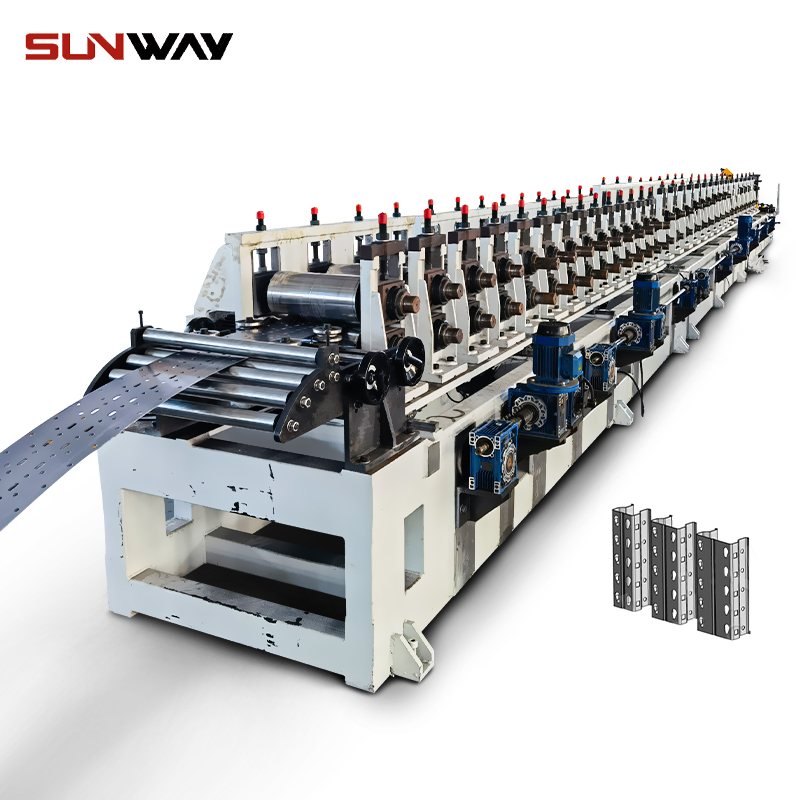
Overcoming these micro-tolerance challenges requires a complete shift in roll forming machinery architecture. Wuxi Sunway Machinery Co., Ltd. has engineered a specialized, heavy-duty production platform designed specifically for the extreme tolerances demanded by modern AS/RS logistics projects.
28–32 Progressive Forming Stations
Traditional machines utilize 16 to 18 forming passes, which subjects high-yield steel to aggressive, localized bending stresses that cause material cracking and internal tension. SUNWAY systems distribute steel deformation across 28 to 32 gradual forming passes. This gradual profiling stress distribution produces perfectly flat, stress-free warehouse shelf uprights with complex Omega or hexagonal cross-sections.
Closed-Loop Servo Punching System
To eliminate cumulative pitch errors, SUNWAY integrates a high-speed, closed-loop servo punching system governed by optical encoders. By continuously monitoring the moving steel strip in real time, the press executes hole patterns with sub-millimeter positioning accuracy. This ensures that every slot cut for an upright shelf bracket aligns perfectly across the entire batch.
3D Multi-Axis Online Straightening Technology
At the exit point of the roll forming mill, SUNWAY equips its lines with a dynamic 3D multi-axis straightening head. This system actively applies corrective force along three physical axes simultaneously, neutralizing natural material twist and bow. This technology achieves a strict straightness tolerance standard of ±5mm per 10 meters (±5mm/10m), producing flawless shelf upright columns that satisfy the most stringent AS/RS engineering codes.
The Domino Effect: How Machinery Precision Impacts AS/RS Project Performance
Investing in high-precision manufacturing equipment creates a positive domino effect across every stage of a commercial warehouse project:
Accelerated On-Site Installation: When every warehouse shelf uprights profile arrives on-site with sub-millimeter straightness and exact slot pitch, installation crews eliminate costly manual adjustments, grinding, or slot filing. Project timelines are reduced dramatically.
Long-Term Structural Safety: Uniform structural tolerances guarantee that static and dynamic loads distribute evenly across all vertical columns, preventing localized metal fatigue during rapid robotic crane operations.
Reduced Scrap & Lower TCO: Automated precision control reduces raw steel waste down to under 1%, protecting the manufacturer’s profit margins while lowering the overall Total Cost of Ownership (TCO).
Tailored Equipment Configurations for High-Bay Logistics Systems
Different automated logistics configurations require specialized machine engineering:
AS/RS Super-Tall Upright Lines: Heavy-gauge rolling setups designed to process high-yield steel (2.5mm - 4.0mm) into deep, heavy-capacity structural warehouse shelf uprights.
Complex Multi-Bend Profiles: Advanced flower pattern tooling engineering designed to roll intricate, multi-faceted shelf upright columns without causing micro-fractures along the profile bends.
High-Speed Interlocking Bracket Systems: Synchronized stamping and forming lines engineered to manufacture seamless interaction points between vertical columns and structural upright shelf bracket connectors.
SUNWAY: Engineering World-Class Precision for Future-Ready Racking Plants
As a pioneer in industrial cold roll forming technology, Wuxi Sunway Machinery Co., Ltd. (SUNWAY) is dedicated to empowering global rack manufacturers with future-ready equipment. We combine advanced profile simulation software with precision in-house CNC roller machining to deliver world-class turnkey production systems.
Every SUNWAY line undergoes rigorous factory testing, including full-load dry runs using customer-specified steel coils, to guarantee that output profiles meet our strict ±0.5mm/10m straightness standard before shipping. If your facility is preparing to bid on upcoming high-bay AS/RS projects, our engineering team is ready to design a custom production layout tailored to your exact profile blueprints.
Take the Next Step: Contact the engineering specialists at SUNWAY today to request a comprehensive technical proposal and customized price quotation for your AS/RS warehouse shelf uprights line.
Commercial ROI: Transforming Precision Capabilities into B2B Market Share
In the enterprise B2B market, manufacturing precision is your strongest sales tool. Demonstrating that your plant operates a 32-station, closed-loop punching line capable of delivering 0.5mm/10m tolerances instantly sets your business apart from low-tier competitors.
This technical certification enables your company to qualify for high-margin mega-fulfillment bids for global logistics brands. By transitioning to automated, continuous high-speed production (15-25m/min), your plant maximizes daily throughput, eliminates structural defects, and secures long-term market leadership in high-precision shelf upright manufacturing.
FAQ: Technical Insights on High-Precision AS/RS Roll Forming
Why is a tolerance of 0.5mm/10m essential for high-bay warehouse shelf uprights?
In automated high-bay facilities reaching heights of 20 to 40 meters, even minor profile bowing accumulates. A tolerance of 0.5mm/10m ensures that vertical columns remain plumb, preventing stacker crane guide rails from narrowing or widening, which could cause automated shuttle jams.
In automated high-bay facilities reaching heights of 20 to 40 meters, even minor profile bowing accumulates. A tolerance of 0.5mm/10m ensures that vertical columns remain plumb, preventing stacker crane guide rails from narrowing or widening, which could cause automated shuttle jams.
How does closed-loop servo punching eliminate pitch errors on an upright shelf bracket slot array?
The closed-loop system uses high-resolution optical encoders to track the exact real-time movement of the steel strip. The PLC adjusts the servo punch press dynamically, eliminating cumulative pitch drift and ensuring that every upright shelf bracket locks in with sub-millimeter accuracy.
The closed-loop system uses high-resolution optical encoders to track the exact real-time movement of the steel strip. The PLC adjusts the servo punch press dynamically, eliminating cumulative pitch drift and ensuring that every upright shelf bracket locks in with sub-millimeter accuracy.
What are the advantages of a 28–32 station machine over traditional 18-station roll formers for complex shelf upright sections?
Spreading the deformation process across 28 to 32 gradual passes reduces stress on high-tensile steel. This prevents material springback, twisting, and corner micro-cracking, yielding a structurally superior shelf upright with uniform geometry.
Spreading the deformation process across 28 to 32 gradual passes reduces stress on high-tensile steel. This prevents material springback, twisting, and corner micro-cracking, yielding a structurally superior shelf upright with uniform geometry.
How can I request a customized technical solution and price quotation from SUNWAY for an AS/RS project?
You can contact our sales engineering team directly through our website www.swracking.com. Submit your profile drawings and production requirements, and our engineers will provide a complete 3D line layout, technical analysis, and detailed cost quotation within 24 hours.
You can contact our sales engineering team directly through our website www.swracking.com. Submit your profile drawings and production requirements, and our engineers will provide a complete 3D line layout, technical analysis, and detailed cost quotation within 24 hours.
Related News

2026-09-30 18
How to Select the Right Roll Forming Machine for Modern Warehouse Storage Racks
2026-09-22 18
How to Choose the Right Upright Rack Roll Forming Machine for Your Warehouse Racking Production?
2026-09-20 20
Precision Cold Roll Forming for Step Beam Pallet Racking & Shelving Systems