manager@wuxisunway.com

+86-13616182007

Box Plate Machine for Heavy-Duty Racking System: A Complete Guide for Manufacturers

November 17, 2025

Box Plate Machine for Heavy-Duty Racking System: A Complete Guide for Manufacturers

In the modern warehouse and logistics industry, heavy-duty pallet racking systems have become the backbone of high-density storage. As storage loads continue to increase and safety standards become stricter, the demand for high-strength, precision-engineered rack components grows accordingly. Among these components, the box plate—a structural element used in box beams and reinforced rack sections—plays a crucial role in load-bearing performance.

To manufacture these components efficiently and consistently, companies rely on a specialized piece of equipment known as the Box Plate Machine for Heavy-Duty Racking System. This article provides an in-depth explanation of what the machine is, how it works, its advantages, and how to select the right model for industrial applications.


1. What Is a Box Plate Machine for Heavy-Duty Racking Systems?

A box plate machine is an automated production line designed to form box-shaped steel plates used in the manufacturing of heavy-duty pallet rack beams, structural reinforcements, and load-bearing components.
It normally processes steel coil or flat sheet material into U-shaped, C-shaped, Z-shaped, or multi-fold box sections, which are later assembled into pallet rack beams such as:

  • Box beams

  • Step beams

  • Structural beams

  • Reinforcement plates

  • Closed box sections used in high-load rack columns

These machines are engineered for high strength, dimensional accuracy, and repeatable quality—key factors in heavy-duty racking performance.


2. Why Box Plates Are Essential for Heavy-Duty Racking

Box plates add structural rigidity to pallet racking systems.
Compared with open-profile metal sections, closed or semi-closed box shapes offer:

2.1 Higher Load Capacity

Box-shaped profiles resist bending and twisting far better than open channels because the material is distributed around the edges of the section.

2.2 Increased Torsional Strength

In pallet racking beams, torsion resistance is critical for stability under uneven loads or forklift impact.

2.3 Better Dimensional Stability

Precision-formed box plates ensure the uniformity required to maintain rack safety and interchangeability of parts.

2.4 Improved Safety Compliance

Manufacturers of heavy-duty racking systems must meet international standards (such as FEM, RMI, and EN regulations). Box plates allow stronger designs with smaller tolerances.

Thus, the box plate machine becomes a vital link in producing components that directly affect rack quality and warehouse safety.

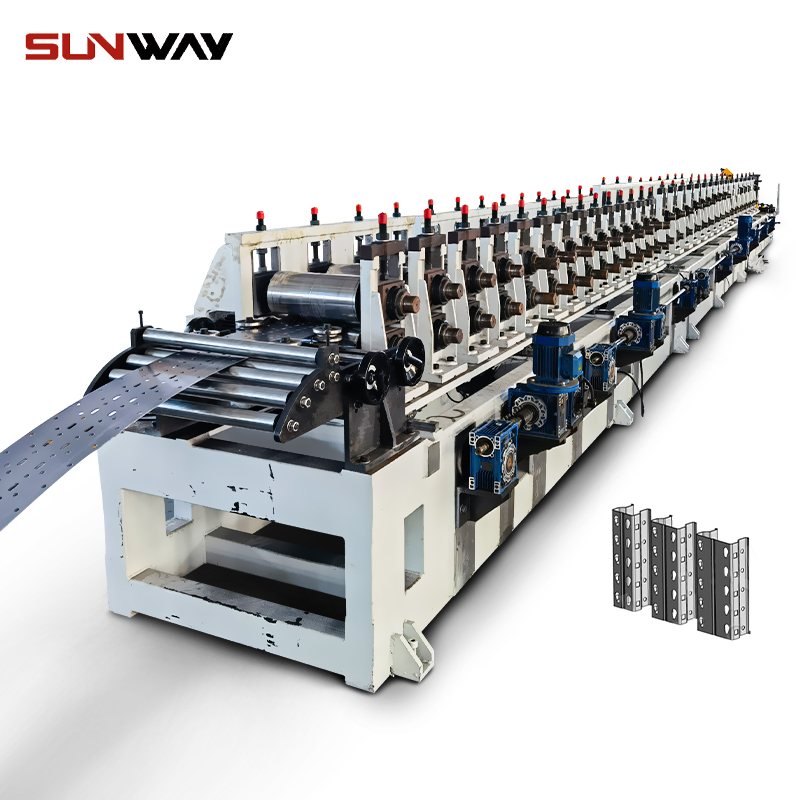
Heavy-duty Box Plate Roll Forming Machine processing wide steel sheet for racking shelves


3. Types of Box Plate Machines

Different production approaches exist depending on efficiency, investment level, and product complexity.

3.1 Roll Forming Box Plate Machine

This is the most common type for high-volume manufacturing.

  • Continuous cold-forming through multiple roll stations

  • Stable production speed (8–20 m/min)

  • High precision and excellent surface finish

  • Suitable for standardized, large-scale racking manufacturing

3.2 Bending Line (Press Brake or CNC Bending Center)

Used for custom profiles or small batches:

  • Flexible shape variations

  • Lower investment

  • Slower production pace

  • Often used for prototyping or low-volume output

3.3 Stamping + Bending + Welding Line

Used for very thick plates:

  • Suitable for 3.0–5.0 mm steel plates

  • Ideal for reinforcement plates or heavy-load beam sections

  • Integrated punching and forming options

Each type has its own advantages depending on material thickness, shape complexity, and production volume.


4. Key Components of a Box Plate Roll Forming Line

A modern box plate roll forming line typically includes:

4.1 Decoiler

Feeds raw steel coil into the production line.

4.2 Leveling System

Eliminates internal stress and ensures the sheet is perfectly flat before forming.

4.3 Servo Feeding + Punching Station

Adds holes, slots, notches, and connection features required by pallet rack designs.

4.4 Roll Forming Stations

The core of the system—multiple roll stands gradually shape the flat material into a box section.

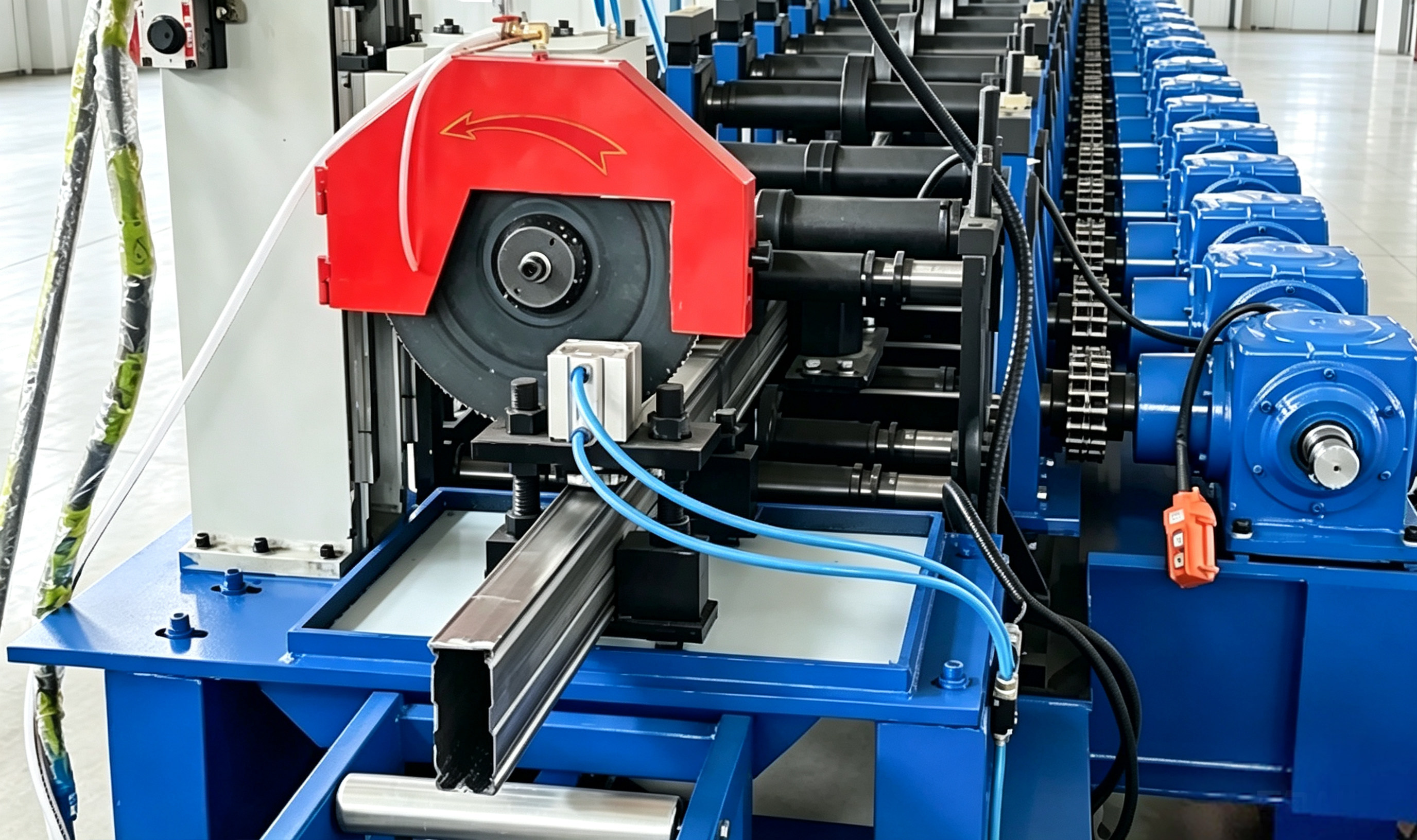
4.5 Cutting System

Hydraulic or flying cutting system ensures clean, accurate lengths without stopping production.

4.6 Output Table and Stacking System

Collects finished products and supports automated packaging if needed.

All components are usually operated through a PLC-controlled automation system, ensuring precision and ease of operation.

Factory layout drawing and dimensions of SUNWAY box plate roll forming line including punching and cutting units


5. Technical Specifications (Typical Range)

Although exact parameters depend on the manufacturer, most heavy-duty box plate machines support:

Parameter Typical Range
Material Cold-rolled steel, hot-rolled steel, galvanized steel
Thickness 1.5–3.5 mm (sometimes up to 5.0 mm)
Width 200–600 mm
Speed 8–20 m/min
Roller material GCr15 or Cr12MoV (heat-treated)
Cutting accuracy ±0.5–1.0 mm
Control Siemens/Mitsubishi PLC with touch screen

These specifications ensure the machine can handle the demanding requirements of industrial pallet rack production.


6. Advantages of Using a Box Plate Machine

6.1 High Structural Strength

The resulting box plates are extremely rigid, ideal for heavy loads.

6.2 Consistent Precision

Roll forming delivers uniform dimensions along the entire length of the product.

6.3 High Production Efficiency

Continuous forming greatly outperforms bending or manual processes.

6.4 Reduced Labor Costs

Automation minimizes human intervention and error.

6.5 Excellent Surface Finish

Cold-forming maintains material integrity with minimal scratches or distortions.

6.6 Customizable for Different Designs

Manufacturers can easily adjust:

  • Beam width

  • Height

  • Fold angles

  • Punching patterns

  • Reinforcement ribs

This makes it adaptable to different pallet rack systems worldwide.


7. Applications in Heavy-Duty Racking Systems

Box plate machines produce key components for:

  • Warehouse pallet racking

  • High-bay storage systems

  • Shuttle racking

  • Drive-in / drive-through racking

  • Automated storage and retrieval systems (AS/RS)

These storage systems depend on high-strength steel beams that are usually manufactured from box plates pressed or roll-formed on these machines.


8. How to Choose the Right Box Plate Machine

When selecting a box plate machine for your production line, consider the following criteria:

8.1 Production Volume

High output → choose a roll forming line
Small batches → choose a bending center

8.2 Material Thickness

Thicker material requires stronger rollers and more powerful drives.

8.3 Required Beam Profiles

Complex shapes may require custom tooling or adjustable roller sets.

8.4 Punching and Cutting Needs

Look for integrated punching stations for efficiency.

8.5 Automation Level

PLC automation, quick changing roller sets, and automatic stacking improve productivity.

8.6 Future Expansion

Choose equipment that can grow with your product line—especially important as logistics demand continues to rise globally.


9. Future Trends in Box Plate Manufacturing

The heavy-duty racking industry is moving toward more intelligent and flexible production:

  • Automated tool changing for quicker profile switching

  • Robotic welding integration with box beam production lines

  • AI-powered quality monitoring using sensors and cameras

  • Energy-efficient forming motors

  • High-strength lightweight materials to reduce steel consumption

These trends will shape the next generation of box plate machines.


Conclusion

A box plate machine for heavy-duty racking systems is a critical piece of industrial equipment that enables manufacturers to produce strong, precise, and high-performance pallet rack components. With continuous roll forming, automated punching, and advanced control systems, these machines provide the efficiency and accuracy required by today’s warehouse storage solutions. As demand for high-density storage grows, investing in a reliable and high-quality box plate machine ensures competitive advantage, consistent product quality, and long-term production efficiency.