


Advanced Cold Roll Forming Technology for High-Precision Racking Upright Production
July 7, 2026
The Evolution of Racking Manufacturing—From Stamping to Continuous Cold Forming
In the modern logistics landscape, the demands placed on warehouse storage infrastructures have escalated dramatically. Facilities are expanding vertically, requiring manufacturing plants to re-evaluate their production methodologies. For decades, traditional localized press-braking and sectional stamping were the default methods for fabricating warehouse vertical supports. However, as the industry transitions toward high-density, multi-tier storage setups, these legacy techniques struggle to meet modern structural benchmarks. Today, advanced cold roll forming technology has emerged as the definitive global standard for manufacturing high-capacity upright shelf components.
Upgrading from manual, batch-processed machinery to an automated, continuous line is no longer just a tactical move to increase plant speed; it is an architectural necessity. To win lucrative B2B contracts for modern logistics hubs, your facility must produce structurally flawless upright frames. This structural integrity depends entirely on how the steel profile is shaped. By implementing integrated cold roll forming systems, manufacturers can ensure that every batch of shelf uprights satisfies stringent international load-bearing and safety standards.
Demystifying Cold Roll Forming Technology for Racking Uprights
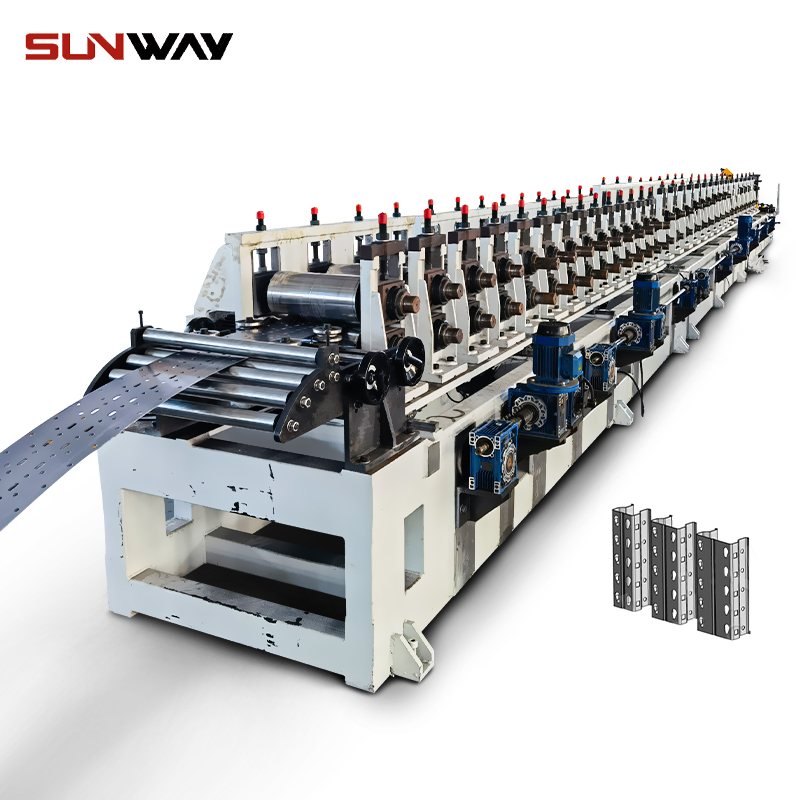
At its engineering core, cold roll forming technology for industrial warehousing is the continuous bending of high-strength steel coils at ambient temperatures. When processing heavy-gauge steel (typically ranging from 2.0mm to 3.5mm or greater) , the metal must be shaped progressively. A modern line forces the strip through a sequence of precisely engineered roller dies. Each pair of rollers performs a calculated, incremental bend, gradually transforming the flat coil into multi-bend, high-load shelf uprights without compromising the steel's internal grain structure.

Managing material behavior during this continuous deformation requires extensive metallurgical expertise. High-tensile steel naturally suffers from elastic recovery, commonly known as material springback, alongside residual localized stress. Advanced roll forming technology counteracts these issues through specialized "flower pattern" tooling designs. By carefully calculating the progressive metal flow across dozens of forming stages, the machine eliminates structural twisting and ensures that each heavy-duty upright shelf leaves the line with perfect dimensional symmetry. This precision is vital because even a millimeter of warping can compromise the assembly of finished upright frames.
Step-by-Step Process Flow: How a Steel Coil Becomes a Heavy-Duty Upright Frame
To understand why this manufacturing method dominates the industry, we must analyze how a synchronized, automated line processes raw material into a ready-to-ship upright shelf:
1.Decoiling & Precision Leveling: The heavy steel coil is unwound and fed into a series of staggered correction rollers. This step removes coil memory and internal flattening stresses, ensuring a perfectly flat strip enters the line.
2.High-Speed Online Punching: Before the steel undergoes profile bending, it passes through a high-speed, servo-driven punching system. For reliable shelf uprights, thousands of teardrop, slot, or hexagonal configurations must be executed with absolute pitch accuracy. This precise spacing is what allows crossbeams to lock securely into the final upright frames.
3.Progressive Cold Roll Forming: The punched strip passes through a series of consecutive forming stations. This progressive rolling shapes the complex Omega or hexagonal geometries required for a heavy-duty upright shelf.
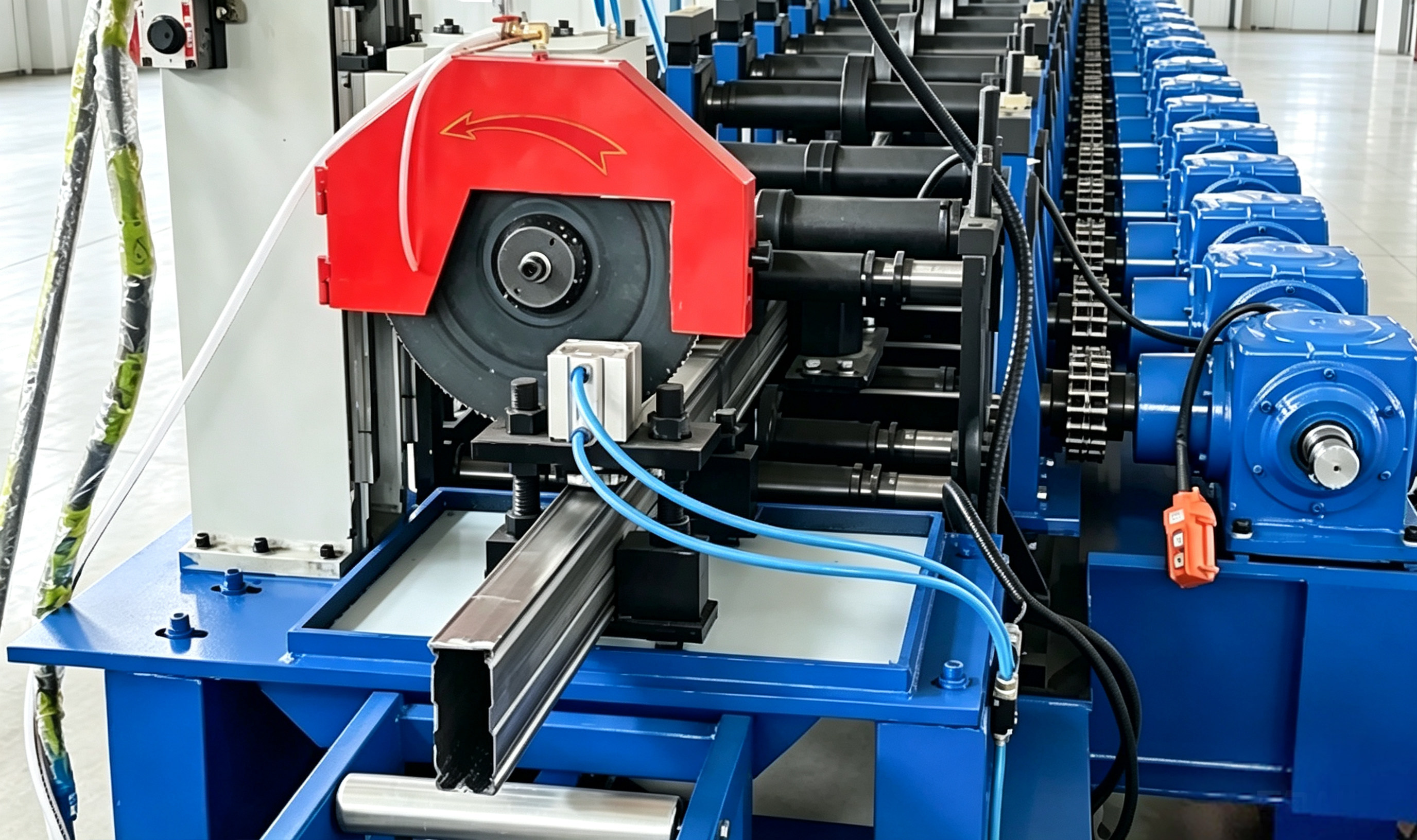
4.Flying Tracking Cut-off: A synchronized servo-driven hydraulic shear or tracking saw cutter slices the moving profile to its exact custom length without stopping the continuous line.
Engineering Verdict: Why Structural Uprights Must Utilize Cold Roll Forming
When evaluating physical performance under load, the engineering data proves that high-capacity upright frames cannot afford the localized micro-fractures frequently caused by traditional press-brake stamping. Traditional pressing stamps the entire length or section of the steel simultaneously, straining the material's grain boundaries at the corners. In contrast, continuous cold roll forming gently guides the metal into position. This gradual shaping induces a phenomenon known as strain hardening, which actually increases the yield strength at the profile's critical corners.
Furthermore, the sectional tolerances achieved through a dedicated line are unmatched. When assembling a massive industrial rack, every single upright shelf must match its counterparts perfectly. If the cross-sectional dimensions vary over a 12-meter height, the structural load distribution fails. Cold roll forming tech guarantees sub-millimeter dimensional consistency across thousands of continuous meters, producing ultra-reliable shelf uprights that form the backbone of safe, stable upright frames.
Related News

2026-09-28 8
How to Select the Right Roll Forming Machine for Modern Warehouse Storage Racks
2026-09-22 13
How to Choose the Right Upright Rack Roll Forming Machine for Your Warehouse Racking Production?
2026-09-20 16
Precision Cold Roll Forming for Step Beam Pallet Racking & Shelving Systems