Manufacturing Heavy-Duty Storage Racks: High-Yield Roll Forming Systems
August 10, 2026
The Rising Global Demand for Heavy-Duty Storage Infrastructure
The global expansion of automated logistics hubs, raw material distribution centers, and heavy industrial warehouses is reshaping the material handling industry. Modern fulfillment infrastructure must accommodate increasingly dense storage profiles and massive pallet loads. To support static load capacities exceeding 20 tons per rack bay, logistics operators rely heavily on high-yield, structural steel storage systems. This shifting operational landscape places unprecedented stress on component manufacturers.
Transitioning from standard commercial shelving (1.5mm - 2.5mm steel) to heavy-duty industrial racking (3.0mm - 4.0mm high-tensile steel) exposes the fundamental limitations of traditional metal fabrication tools. Conventional press brakes and stamping presses struggle to handle heavy-gauge steel coils without causing severe equipment wear, dimensional drift, and structural fatigue. To maintain high throughput and meet strict safety standards, enterprise racking manufacturers are adopting advanced industrial automation. Investing in a dedicated shelf rack upright roll forming machine has become the industry standard for scalable, high-tonnage storage rack production.
Engineering Rigor: Why Heavy-Duty Racking Imposes Strict Manufacturing Demands
Processing thick high-strength steel into load-bearing columns introduces complex metallurgical and structural engineering challenges.
Managing High-Yield Steel (3.0mm - 4.0mm): Heavy structural columns require high-yield steel alloys that exhibit intense material memory and springback. When passing through forming dies, thick steel exerts massive counter-force on machine shafts, causing standard equipment frames to flex and misalign.
Load Distribution Integrity: Heavy pallet racks must maintain absolute structural geometry along their entire length. Any cross-sectional distortion or uneven bend radius creates localized stress concentrations. Under extreme vertical loads, these minor material flaws can lead to structural buckling and premature rack failure.
The Flaw of Welded Column Joints: To reach high warehouse ceilings, columns frequently extend beyond 12 meters in height. Legacy fabrication methods often require welding shorter press-braked segments together. However, structural welds create heat-affected zones (HAZ) that compromise steel integrity. For true heavy-duty applications, manufacturers require continuous, seamless 12-meter-plus structural columns rolled directly from raw steel coil.
Beyond Stamping: How Advanced Roll Forming Executes Heavy-Gauge Manufacturing
Overcoming the physical limits of heavy-gauge metal processing requires an integrated, high-tonnage production line architecture.
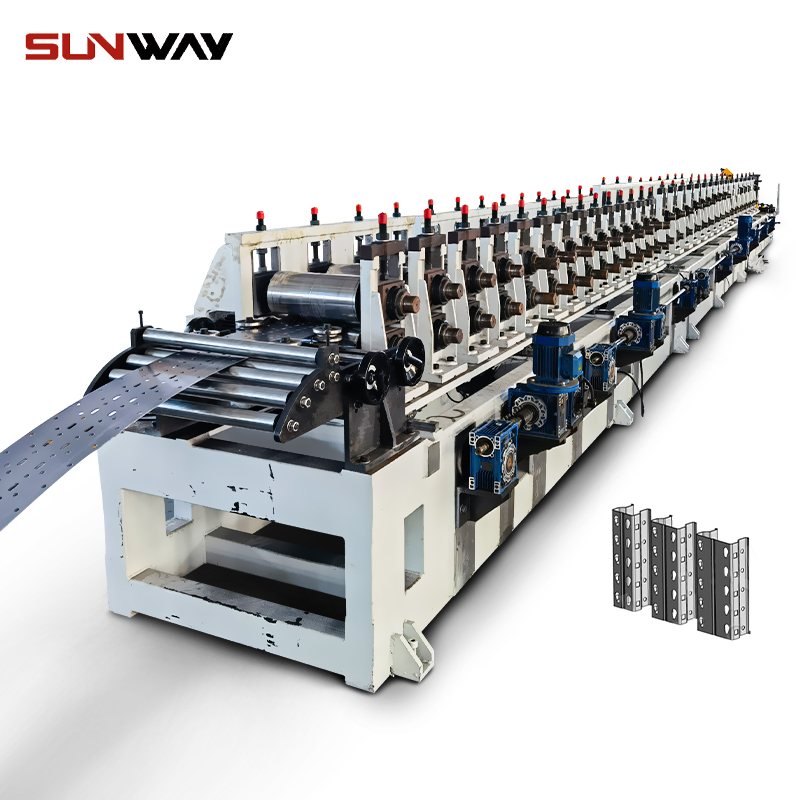
Unlike aggressive single-stage stamping, a specialized rack roll forming machine transforms flat steel into complex open profiles through continuous, progressive deformation. Raw steel coil feeds continuously into an uncoiler and high-precision leveling unit to relieve internal material stress. The strip then moves into a high-tonnage servo hydraulic press array, executing intricate slot patterns without pitch drift.
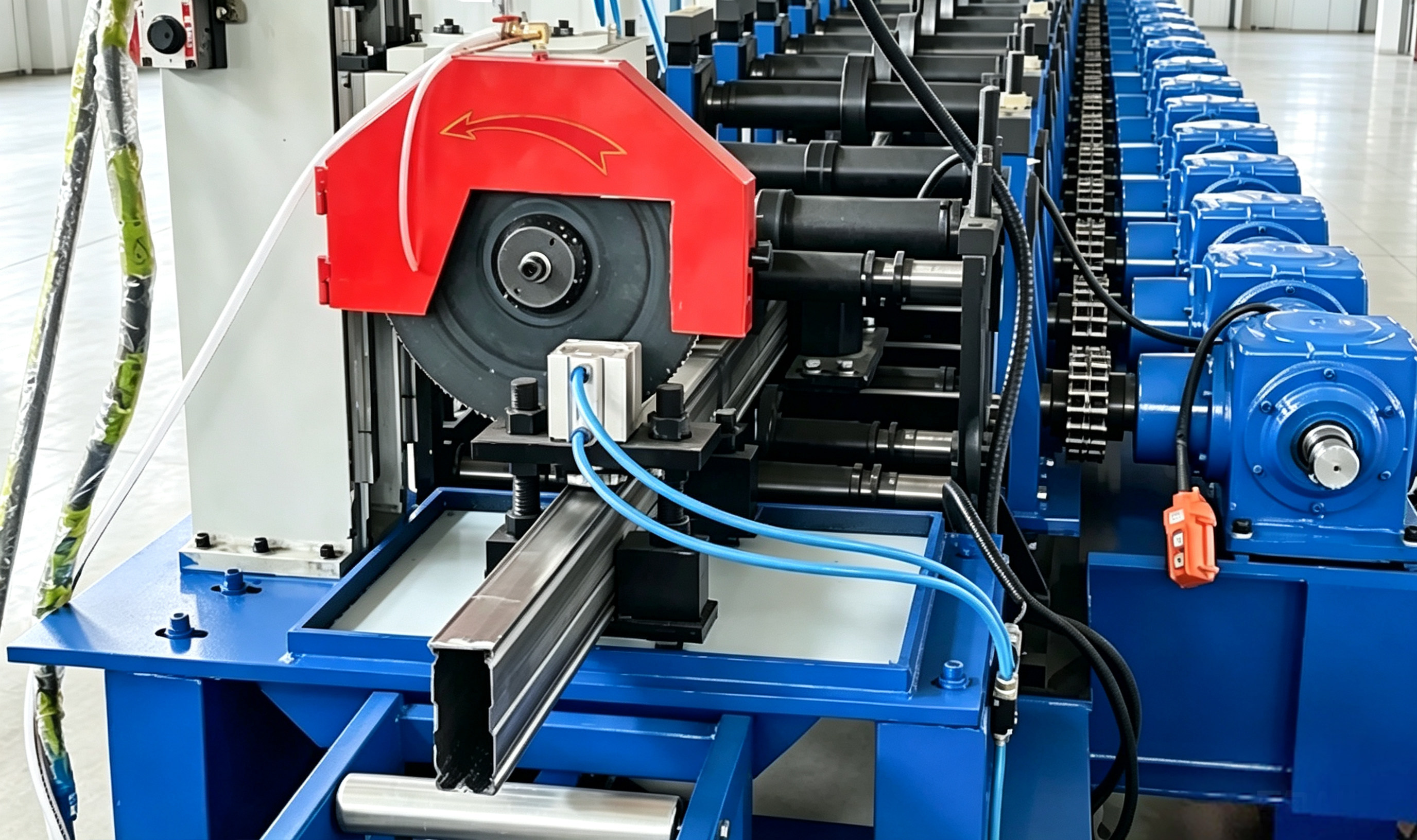
From there, the punched steel enters the main forming mill, passing through dozens of sequential roller dies. Each roller set shapes the steel incrementally, forming deep Omega or hexagonal channels without damaging the material grain structure. Finally, a flying hydraulic shear cuts the finished structural column to exact length—delivering continuous, burr-free storage rack roll forming machine output ready for immediate powder coating and deployment.
Head-to-Head: Continuous Heavy Roll Bending vs. Legacy Press-Braking
Choosing between continuous cold roll forming and legacy press-braking directly determines a factory's profitability and product quality when processing heavy steel.
| Manufacturing Parameter | Legacy Press-Braking | High-Tonnage Roll Forming Line |
| Max Profile Length | Restricted (typically 3m–6m max) | Unlimited continuous lengths (12m–18m+) |
| Production Speed | Slow (Manual stroke-by-stroke) | High-speed automated (15-20m/min) |
| Corner Integrity | High risk of micro-fracturing on 3.5mm+ steel | Gradual deformation preserves ductility |
| Slot Alignment | Prone to human positioning error | Sub-millimeter servo-punched accuracy |
| Structural Integrity | Requires welded joints for long columns | 100% seamless single-piece construction |
Operating a high-capacity rack roll forming machine eliminates the structural vulnerabilities associated with welded column joints. By shaping high-yield 4.0mm steel incrementally, cold roll forming distributes material stress evenly across every radius bend. This preserves the internal grain structure of the steel, eliminating the corner micro-cracks that commonly occur during rapid press-brake stamping.
Heavy-Duty Machine Architecture: Crucial Hardware Specs for High-Load Rolling
Processing 3.0mm - 4.0mm+ steel requires rugged, purpose-built machinery hardware. Standard lightweight machine frames will degrade rapidly under heavy rolling torque.
Cast-Iron Independent Stands (Gantry Frame): Standard equipment builders often use thin, welded steel plates for station housing. Under heavy rolling loads, these plates flex, causing profile distortion. Enterprise systems utilize heavy-duty, solid cast-iron arch stands (gantry frames) for every station. Cast iron provides superior structural rigidity and vibration absorption, keeping roller dies locked in alignment.
Forged Solid Shafts (∅90mm - ∅110mm): To handle high rolling resistance, machine main shafts must be forged from high-grade alloy steel (40Cr or 42CrMo), heat-treated, and precision-ground to solid diameters of ∅90mm to ∅110mm. Solid heavy shafts prevent shaft deflection, ensuring consistent cross-sectional dimensions on every shelf rack upright roll forming machine pass.
High-Tonnage Servo Hydraulic Punching System: Punching thousands of slots through 4.0mm high-yield steel requires massive hydraulic force. Heavy lines integrate specialized multi-cylinder hydraulic punching power units paired with high-speed servo feeders to deliver clean, burr-free hole patterns at continuous production speeds.
Comprehensive Heavy Racking Line Profiles: Uprights & Box Beams
A complete heavy-duty warehouse installation requires more than just vertical columns; it demands an integrated structural ecosystem.
Heavy-Duty Upright Profiles: High-gauge Omega profiles engineered with multi-stage stiffening ribs to handle extreme static and dynamic loading in high-bay pallet systems.
Heavy-Duty Box Beam Lines: Specialized interlocking box beam lines designed to shape and continuously seam-weld dual C-channels into high-capacity horizontal beams capable of supporting heavy pallet loads.
Structural Bracing Lines: High-speed continuous lines designed to roll high-rigidity C-section and hat-section cross-bracing components that stabilize vertical column frames.
The OEM Shift: Why Global Contract Manufacturers Invest in Heavy-Gauge Automation
Contract fabricators operating in the global supply chain face intense pressure on lead times and production costs. Upgrading to a specialized storage rack roll forming machine delivers immediate competitive advantages:
Winning Enterprise Bids: Tier-one warehouse developers demand certified component tolerances and single-piece column construction. Operating high-rigidity equipment allows OEMs to pass strict structural audits.
Drastic Scrap Reduction: Automated coil handling, precision leveling, and closed-loop hydraulic shearing reduce expensive heavy-gauge steel scrap to under 1%.
Eliminating Field Assembly Delays: Delivering perfectly straight, accurately punched columns guarantees smooth on-site installation, protecting the manufacturer's market reputation.
Sourcing Heavy Equipment: Partnering with SUNWAY Machinery
Manufacturing structural components for high-load storage systems requires an equipment partner that understands heavy-gauge steel processing. Wuxi Sunway Machinery Co., Ltd. (SUNWAY) is a global engineering leader specializing in high-capacity cold roll forming systems.
The SUNWAY Heavy-Duty Engineering Advantage:
Cast-Iron Stand Construction: Engineered with solid cast-iron housing units that absorb rolling shock and resist structural deflection during heavy-gauge production.
High-Tonnage Hydraulic Punching: Equipped with custom-designed servo hydraulic punching arrays that punch thick steel plate cleanly and accurately.
Rigorous Full-Load Factory Testing: Every SUNWAY shelf rack upright roll forming machine undergoes mandatory 1:1 dry runs using customer-supplied heavy steel coil (3.5mm - 4.0mm+) prior to factory release.
If your plant is expanding its heavy-duty production capacity, SUNWAY engineers are ready to design a custom line tailored to your specific profile drawings and material specifications.
Upgrade Your Production Line: Contact the engineering specialists at SUNWAY today to request a comprehensive technical consultation and customized price quotation for your high-capacity rack roll forming machine.
FAQ: Technical Insights on Heavy-Gauge Racking Roll Forming
What thickness of steel can a heavy-duty rack roll forming machine process?
A heavy-duty rack roll forming machine is specifically engineered to process high-yield structural steel ranging from 3.0 mm up to 4.0mm+ in thickness. This enables the production of high-load columns for industrial pallet racking, drive-in systems, and heavy cantilever racks.
Why are cast-iron stands superior to welded steel frames on a storage rack roll forming machine?
Cast-iron stands provide significantly higher structural rigidity and vibration dampening compared to welded steel plates. When processing heavy 4.0mm steel, cast-iron housing prevents frame flexing, ensuring long-term dimensional stability and protecting the roller dies from premature wear.
How does continuous roll forming prevent corner cracking on heavy 4.0mm steel?
Unlike single-stroke press brakes that force steel into sharp bends rapidly, cold roll forming bends the material gradually across 24 to 32 sequential passes. This progressive deformation preserves the internal grain structure and ductility of the steel, preventing micro-fractures along tight profile corners.
What full-load testing protocols does SUNWAY perform before shipping heavy-gauge machinery?
Before factory sign-off, SUNWAY conducts full-load dry runs using the client's specified raw steel coils (up to 4.0mm high-yield steel). We inspect output profile dimensions, hole pitch accuracy, and straightness to ensure the shelf rack upright roll forming machine meets strict project standards before shipping.
Related News
2026-07-28 23
The 2026 Smart Warehousing Boom: Precision Roll Forming for AS/RS Racking Manufacturing
2026-07-22 23
Custom Roll Forming Solutions for OEM Racking Manufacturers: Engineering Precision & Co-Development
2026-07-15 27
Automated Roll Forming Systems: Turnkey Production Solutions for Industrial Racking