


How to Optimize Warehouse Shelf Upright Production: A Comprehensive Roll Forming Guide for Manufacturers
May 21, 2026
1. Introduction: The High-Efficiency Era of Warehouse Racking Upright Manufacturing
The global logistics, e-commerce, and cold-chain industries are experiencing unprecedented growth. This surge has placed immense pressure on warehouse storage system fabricators. Supply chain managers no longer just ask for standard racking; they demand hyper-customized, heavy-duty setups with massive load capacities and ultra-fast lead times. At the heart of these structural setups is the vertical upright profile—the primary component responsible for bearing vertical structural loads.
For factory owners, relying on legacy manufacturing methods to produce these vital components is no longer viable. Traditional methods, such as utilizing a manual press brake to bend individual pre-punched sections, introduce heavy bottlenecks. These slow cycles make it impossible to handle massive high-volume orders. To survive this market shift, modern factories must transition from multi-step component piecework to a fully integrated, automated, and continuous line model. For those looking to scale, partnering with an experienced forming machine manufacturer is the definitive first step toward unlocking modern industrial output.
2. What Is a Warehouse Shelf Upright Rack Roll Forming Machine?
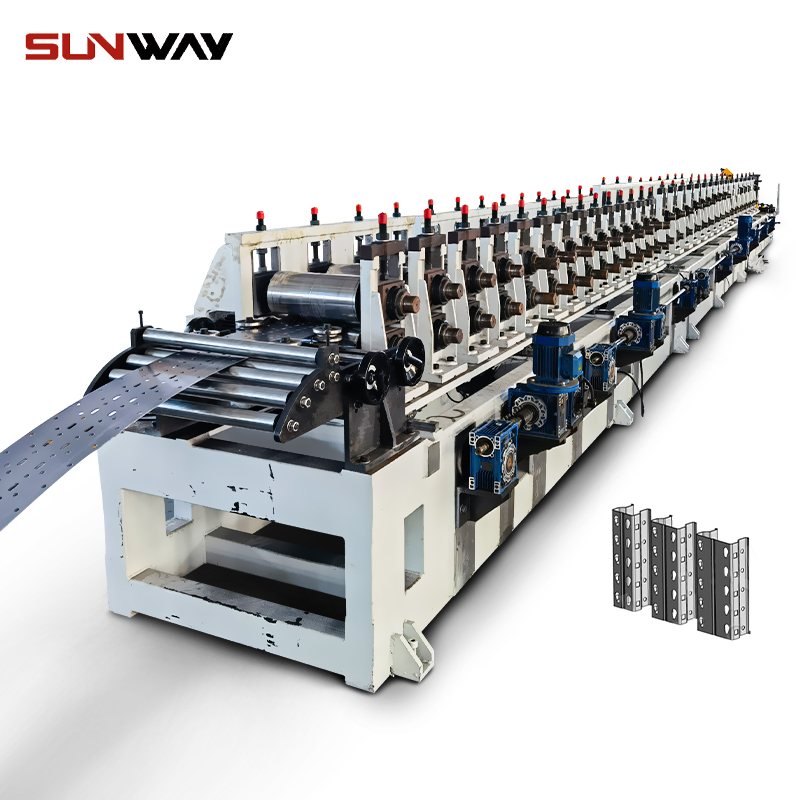
A modern industrial upright manufacturing line is far more than a basic piece of workshop machinery. It functions as a highly sophisticated, synchronized industrial automation matrix. It is engineered to transform flat structural raw material into a deeply complex structural pillar in a matter of seconds.
As a premier roll forming supplier, SUNWAY custom-tailors these advanced systems to execute heavy material processing with effortless continuity. A high-yield automated production system seamlessly synchronizes multiple intricate sub-stations.By working closely with an engineering-focused roll forming equipment manufacturer, a factory can acquire an integrated setup that utilizes continuous uncoiling, multi-stage cold bending, automatic punching, and synchronized non-stop flying cutting. This ensures peak industrial efficiency.
3. Step-by-Step Breakdown: The Core Manufacturing Process of Racking Uprights
To appreciate the high mechanical engineering value of this automated process, one must analyze the raw steel sheet's progressive journey down the line, as illustrated in the technical Elevation Flow Chart of a standard SUNWAY production solution.
[Hydraulic Decoiler] → [Servo Feeder] → [Leveller & Hydraulic Punching Unit] → [Storage Table → Feeder → Roll Forming System] →[Servo Track Cutting → Out Table]
Step 1: Decoiling and Primary Servo Feeding
Heavy-gauge structural steel coils are loaded onto the Hydraulic Decoiler. The steel strip is systematically guided into the line via an independent Servo Feeder. This initial servo-driven coordination ensures precise tension control and smooth material payout from the very beginning of the line.
Step 2: Precision Leveling and Hydraulic Punching
The raw metal then passes through the integrated Leveller, which eliminates any inherent coil set or internal stresses to guarantee absolute flatness. Immediately following the leveling process, the material enters the heavy-duty Hydraulic Punching Unit. Controlled by high-precision indexing, this station punches complex racking hole patterns (such as teardrop or butterfly slots) with sub-millimeter positioning accuracy.
Step 3: Advanced Storage Table and Looping System
Unlike rigid, low-end machines, SUNWAY integrates a specialized Storage Table (looping system) immediately after the punching unit. Because punching requires a momentary pause (intermittent motion) while roll forming demands a continuous flow (continuous motion), the deep material loop acts as a vital speed buffer. This advanced synchronization prevents material pulling, eliminates mechanical stress, and allows the line to run at higher speeds without deformation.
Step 4: Secondary Feeding and Multi-Station Roll Forming
Exiting the storage loop, a secondary Feeder stabilizes and aligns the punched metal strip before it enters the massive Roll Forming System. This system utilizes a series of custom-engineered sequential roll tooling stations. Each consecutive roller pair deforms the steel progressively, shaping the complex Omega or C-channel profiles step-by-step while maintaining uniform material thickness and preventing surface scratches.
Step 5: High-Speed Servo Track Cutting and Discharge
The formed upright profile finally reaches the Servo Track Cutting unit (flying shear). Powered by a synchronized servo drive, the cutting blade tracks the moving profile and cuts it to the exact pre-programmed length on the fly, ensuring zero downtime. The immaculate, finished racking uprights are then discharged onto the Out Table, sorted, and prepared for final assembly or coating.

4. Why Roll Forming Technology Is Essential for Upright Manufacturing
When comparing a dedicated automated line to a traditional manual press brake setup, the manufacturing advantages become obvious:
| Feature / Metric | Traditional Press Brake Setup | SUNWAY Industrial Roll Forming Line |
| Production Speed | Very Slow (1-2 meters/minute average) | Ultra-Fast (15-25 meters/minute continuous) |
| Labor Requirement | High (Requires 3-5 skilled operators) | Minimal (1 single line technician) |
| Structural Integrity | Variable (Prone to human error & stress cracks) | Consistent (Work-hardened for maximum strength) |
| Length Limitation | Restricted by the physical bed width of the press | Virtually Unlimited (Can easily run 12m+ sections) |
Furthermore, the continuous rolling process yields a distinct metallurgical advantage: work-hardening. As the steel passes through successive heavy rollers, its mechanical yield strength naturally increases. This allows manufacturers to produce lighter upright profiles that maintain or exceed traditional weight-bearing capacities, saving significant raw material costs.
5. Equipment Selection Guide: How to Choose the Right Upright Roll Forming Line?
Selecting a new line is a critical long-term investment. To choose a system that aligns with your factory's production needs, consider these crucial technical factors:
Material Gauge and High-Strength Steel Capabilities: Ensure your roll forming equipment manufacturer builds the machine frame with heavy-duty cast steel pillars or solid thick-walled plate structures. Heavy, thick structural racking profiles require robust gearboxes and heavy-duty drive shafts to handle high-yield materials without mechanical deflection.
Punching Flexibility and Die Configurations: If your factory manufactures multiple styles of racking, look for an adaptable hydraulic punching station with quick-change die cassettes. This allows operators to switch from teardrop to European hook styles with minimal downtime.
Changeover System Efficiency: If you frequently produce different upright sizes (e.g., changing web widths from 90mm to 120mm), opting for a Duplex Roll Forming System or a Quick-Change Cassette System is highly recommended. Rather than manually adjusting individual rollers over several hours, automated width adjustments can be completed via PLC in under ten minutes.
Advanced Controls for Deflection and Twist: High-quality lines incorporate universal straightener blocks at the exit gate. Working with an expert forming machine manufacturer ensures your system can adjust for natural twist, camber, and bow on the fly, keeping your scrap rate under 1%.
6. Typical Applications: Common Racking Upright Profiles and Designs
A versatile industrial line can accommodate a broad array of product variants, enabling factories to fulfill diverse commercial contracts:
Heavy-Duty Pallet Racking Uprights: Thick-gauge profiles (often 2.5mm - 3.5mm) with deep multi-bend geometries, engineered to handle heavy industrial pallet storage.
Medium-Duty Retail and Shelving Columns: Lighter configurations (1.5mm - 2.0mm) optimized for rapid assembly in commercial environments.
High-Bay ASRS Integration Uprights: Ultra-precise, long-run upright profiles designed specifically for high-density Automated Storage and Retrieval Systems, where even minor deviations can disrupt automated robotic cranes.
As a versatile, global roll forming supplier, SUNWAY can easily engineer custom rolling dies tailored to match your precise proprietary profile drawings.
7. Economic Impact: ROI and Production Efficiency Analysis
Upgrading your manufacturing facility with equipment from an established roll forming equipment manufacturer yields immediate financial benefits.
Consider a standard factory producing 20,000 meters of high-grade upright profiles monthly. Using a traditional press brake, this output demands multiple production shifts, several high-tonnage machines, and substantial labor expenses. By switching to a high-speed continuous line, the same volume can be produced in just a few working days with a single line operator.
Additionally, precision automated in-line trimming cuts raw material waste to less than 1%, down from the typical 5-7% scrap rate seen in multi-machine setups. This raw steel optimization directly boosts your bottom-line profitability.
8. Why Partner with SUNWAY as Your Professional Roll Forming Supplier?
Successfully upgrading your factory floor requires more than just standard machinery—it demands a trusted partnership with an expert industrial forming machine manufacturer.
Wuxi Sunway Machinery Co., Ltd. (SUNWAY) brings over a decade of deep engineering expertise directly to your facility. We don't just supply individual machines; we design and deliver fully integrated, turnkey industrial systems. From custom rolling die design and advanced software integration to on-site setup and global technical support, SUNWAY ensures your line runs flawlessly from day one. Choosing us as your dedicated roll forming supplier means investing in a high-efficiency production asset built for long-term reliability.
9. FAQ: Critical Questions Answered for Racking Production Upgrades
Q: Can one single roll forming machine handle multiple upright sizes?
A: Yes. By choosing a line designed by an advanced roll forming equipment manufacturer like SUNWAY, you can integrate a fully automated, PLC-driven width adjustment system. This enables the machine to adjust its roll stands for different profile sizes automatically.
A: Yes. By choosing a line designed by an advanced roll forming equipment manufacturer like SUNWAY, you can integrate a fully automated, PLC-driven width adjustment system. This enables the machine to adjust its roll stands for different profile sizes automatically.
Q: How do you prevent surface scratching on pre-galvanized steel?
A: Our specialized roll tooling is precision-machined using high-grade Cr12MoV die steel, which undergoes vacuum heat treatment and hard chrome plating. This ensures an ultra-smooth finish that protects zinc coatings during the bending process.
A: Our specialized roll tooling is precision-machined using high-grade Cr12MoV die steel, which undergoes vacuum heat treatment and hard chrome plating. This ensures an ultra-smooth finish that protects zinc coatings during the bending process.
Q: What is the average lead time for a custom production line?
A: As a reliable and efficient forming machine manufacturer, our typical delivery cycle spans 60 to 90 days. This timeline covers custom engineering design, precision roll tooling fabrication, comprehensive factory testing, and international shipping preparation.
A: As a reliable and efficient forming machine manufacturer, our typical delivery cycle spans 60 to 90 days. This timeline covers custom engineering design, precision roll tooling fabrication, comprehensive factory testing, and international shipping preparation.
Related News

2026-09-28 8
How to Select the Right Roll Forming Machine for Modern Warehouse Storage Racks
2026-09-22 13
How to Choose the Right Upright Rack Roll Forming Machine for Your Warehouse Racking Production?
2026-09-20 16
Precision Cold Roll Forming for Step Beam Pallet Racking & Shelving Systems