


The Complete Production Guide for Warehouse Rack Upright Roll Forming Lines
June 12, 2026
Introduction: The Evolution of the Racking Upright into a High-Precision Structural Component
The global warehousing, material handling, and logistics sectors are experiencing a major structural shift. Driven by the expansion of cross-border e-commerce hubs, modern multi-tier mezzanines, and high-bay Automated Storage and Retrieval Systems (ASRS), storage layouts must optimize vertical space like never before. In these modern configurations, the structural upright column is no longer treated as a basic piece of punched steel channel. Instead, it functions as a highly engineered safety component engineered to bear massive vertical structural loads under extreme dynamic conditions.
As warehouse footprints grow vertically, structural load demands require absolute geometric uniformity across every single profile. Achieving this high level of structural consistency is a major challenge for legacy metal fabrication shops. Traditional workshop piecework methods can no longer deliver the tight sub-millimeter tolerances required for modern interlocking rack assemblies.
To transform the vertical upright from a variable, hand-processed workshop component into a highly standardized, high-performance structural product, global manufacturers must upgrade their infrastructure. For ambitious factories aiming to remain competitive, transitioning away from discrete manual sheet processing toward continuous automated production lines is an essential strategic objective.
Technical Overview: What Is an Automated Rack Upright Roll Forming Line?
A modern industrial-grade vertical column production setup is far more than a basic cold bending machine. It functions as a highly synchronized, automated engineering matrix that transforms flat steel coils into complex, multi-bend pillars in a single continuous pass.
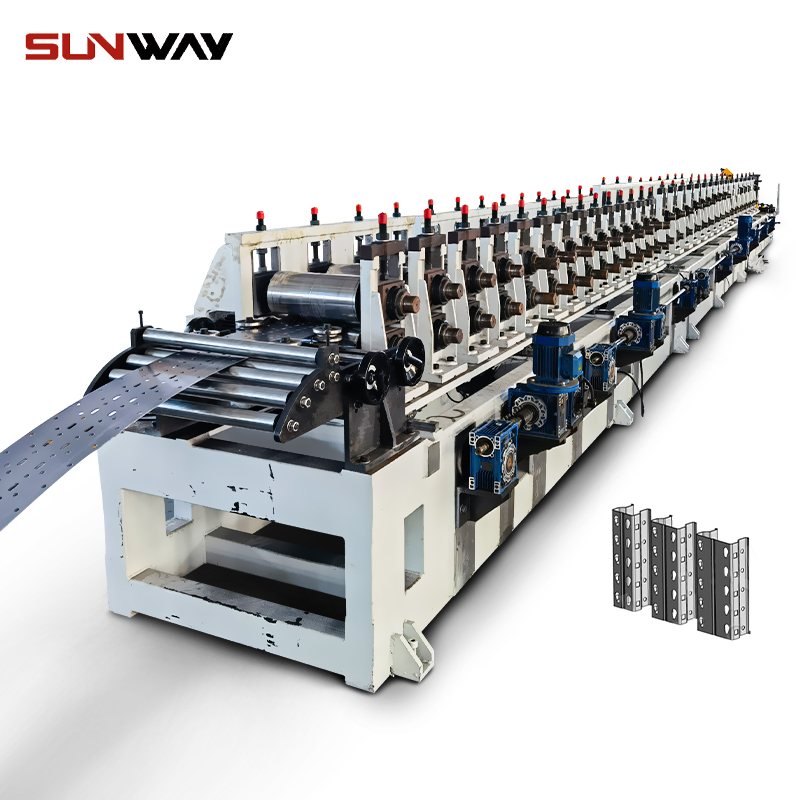
When evaluating equipment partners among global roll form machine manufacturers, it is vital to source from a builder that treats the production line as a fully integrated ecosystem rather than a collection of separate stations. As a specialized engineering pioneer, SUNWAY designs every automated rack upright roll forming machine system to sync multiple core processing actions into a single continuous workflow:
[Hydraulic Decoiler] → [Servo Feeder] → [Leveller & Hydraulic Punching Unit] → [Storage Table] → [Feeder] → [Roll Forming System] → [Servo Track Flying Shear] → [Out Table]
By sourcing your setup from established roll form machine manufacturers, you acquire a heavy-duty production asset built for long-term industrial reliability. These high-yield manufacturing lines seamlessly combine heavy material handling, high-speed inline hydraulic punching, progressive cold roll forming, and synchronized flying cut-off systems under a centralized automated network, delivering peak industrial throughput.
The Industrial Sequence: Step-by-Step Racking Upright Manufacturing Process
To appreciate the high mechanical engineering value of this automated process, one must analyze the raw steel sheet's progressive journey down the line, as illustrated in the technical Elevation Flow Chart of a standard SUNWAY production solution.

Phase 1: Decoiling and Primary Servo Feeding
Heavy-gauge structural steel coils are loaded onto the Hydraulic Decoiler. The steel strip is systematically guided into the line via an independent Servo Feeder. This initial servo-driven coordination ensures precise tension control and smooth material payout from the very beginning of the line.
Phase 2: Precision Leveling and Hydraulic Punching
The raw metal then passes through the integrated Leveller, which eliminates any inherent coil set or internal stresses to guarantee absolute flatness. Immediately following the leveling process, the material enters the heavy-duty Hydraulic Punching Unit. Controlled by high-precision indexing, this station punches complex racking hole patterns (such as teardrop or diamond slots) with sub-millimeter positioning accuracy.
Phase 3: Storage Table and Looping System
Unlike rigid, low-end machines, SUNWAY integrates a specialized Storage Table (looping system) immediately after the punching unit. Because punching requires a momentary pause (intermittent motion) while roll forming demands a continuous flow (continuous motion), the deep material loop acts as a vital speed buffer. This advanced synchronization prevents material pulling, eliminates mechanical stress, and allows the line to run at higher speeds without deformation.
Phase 4: Secondary Feeding and Multi-Station Roll Forming
Exiting the storage loop, a secondary Feeder stabilizes and aligns the punched metal strip before it enters the massive Roll Forming System. This system utilizes a series of custom-engineered sequential roll tooling stations. Each consecutive roller pair deforms the steel progressively, shaping the complex Omega or C-channel profiles step-by-step while maintaining uniform material thickness and preventing surface scratches.
Phase 5: High-Speed Servo Track Cutting and Discharge
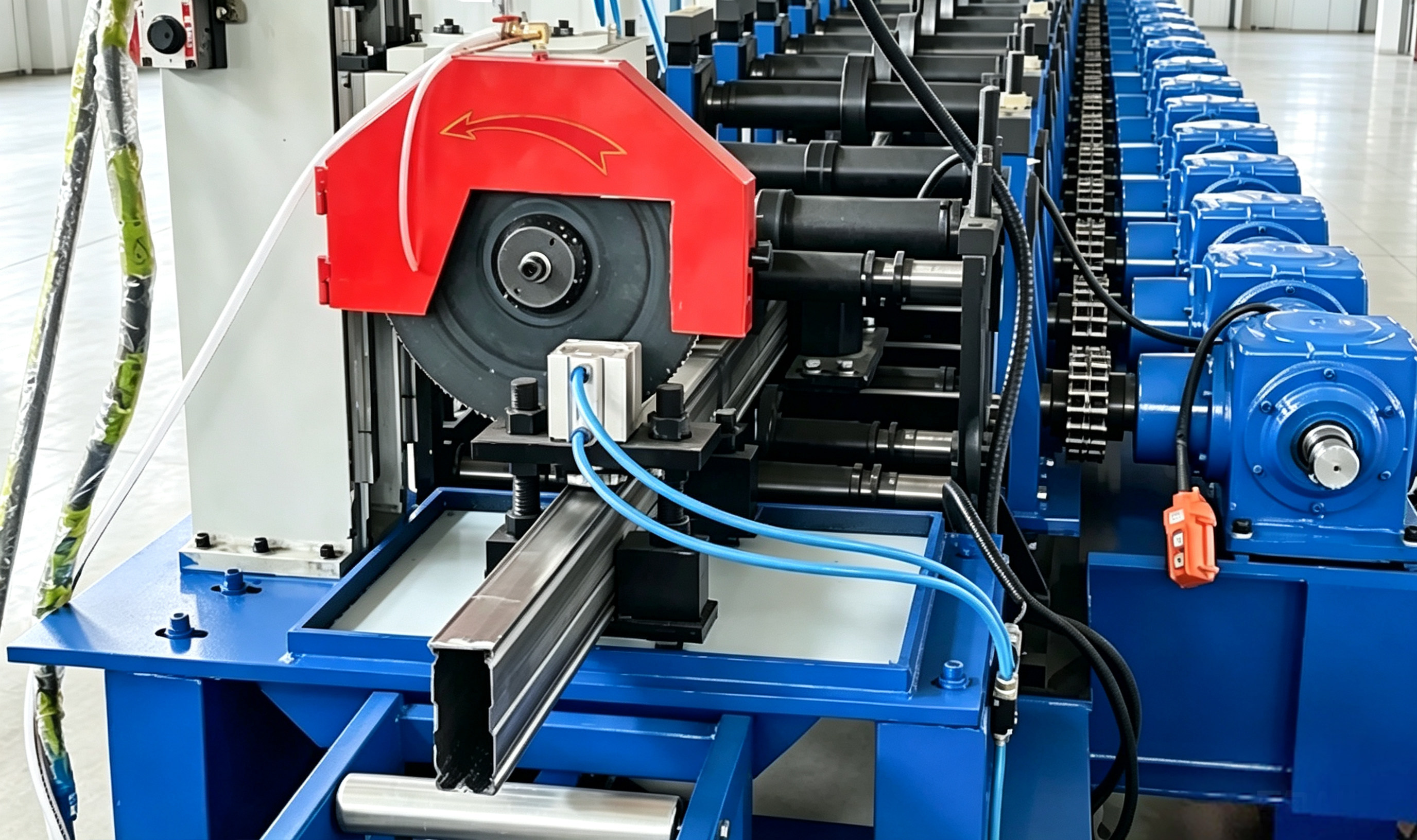
The formed upright profile finally reaches the Servo Track Cutting unit (flying shear). Powered by a synchronized servo drive, the cutting blade tracks the moving profile and cuts it to the exact pre-programmed length on the fly, ensuring zero downtime. The immaculate, finished racking uprights are then discharged onto the Out Table, sorted, and prepared for final assembly or coating.
Hard Truths: Why Traditional Workshops Must Upgrade to Roll Forming Technology
Comparing an integrated continuous line to legacy workshop methods highlights the clear competitive advantages of modern automated production.
Overcoming Length Limitations: Standard hydraulic press brakes are restricted by the physical bed width of the machine. Fabricating specialized 12-meter-long uprights for high-bay ASRS configurations requires joining multiple shorter sections together, introducing structural vulnerabilities and increasing assembly labor costs. A dedicated rack upright roll forming machine can continuously process virtually unlimited lengths in a single pass.
Eliminating Material Spring-Back Disalignments: Traditional multi-station processing typically relies on a segmented sequence: raw sheets are first punched at a standalone press, then manually moved to a press brake for bending. Because structural steel exhibits variable material spring-back across different batches, bending pre-punched sheets manually often distorts the alignment of the hole spacing. This variance creates significant alignment issues during field installation.
Reducing Direct Labor and Operational Risks: Legacy workshop environments depend heavily on multiple skilled machine operators to manually move heavy structural blanks between stations. This labor-intensive process increases direct personnel costs and elevates the risk of material handling damage or shop floor injuries.
Equipment Selection Guide: How to Configure a High-Performance Upright Production Line?
Investing in a new automated production line requires careful consideration of key technical specifications to ensure the machinery matches your long-term output goals. When evaluating quotes from various roll forming machine manufacturers in china, pay close attention to these vital configurations:
The Drive System Configuration
Heavy-gauge structural steel processing requires an incredibly robust mechanical drive. While lighter applications can utilize simple chain drives, a heavy-duty rack upright roll forming machine engineered for 3.0mm+ steel should be configured with an independent gearbox drive system. Independent gearboxes with hardened universal joint connections ensure uniform torque distribution across all forming stations, preventing mechanical deflection and extending tooling lifespan.
Punching System Versatility
To efficiently fulfill diverse customer contracts, your inline punching station should feature maximum flexibility. Selecting an adaptable hydraulic punching press with quick-change die cassettes allows operators to switch from teardrop to European hook styles with minimal downtime, expanding your market reach.
Tooling Changeover System Efficiency
If your factory frequently switches between different upright dimensions, manual adjustment of individual roller spacers can lead to hours of lost production time. Opting for an automated duplex roll forming system or a quick-change cassette system allows width modifications to be handled automatically via the PLC touchscreen interface in under ten minutes, optimizing daily machine utilization.
Real-World Applications: The Versatile Roles of Uprights in Modern Warehousing
A versatile, high-performance production line enables your factory to produce a comprehensive portfolio of industrial storage components:
Heavy-Duty Pallet Racking Uprights: Thick-gauge profiles (often 2.5mm - 3.5mm) with complex multi-bend geometries, engineered to handle heavy industrial pallet storage.
Drive-In Racking Systems: High-density configurations that require exceptional vertical straightness and consistent profile geometry to withstand ongoing material handling impacts.
Multi-Tier Mezzanines and Catwalks: Structural frameworks requiring precise, long-run upright sections to safely support elevated platform walkways.
Partnering with an experienced partner among top roll form machine manufacturers ensures that your system's rolling dies are custom-engineered to match your precise proprietary profile drawings across all these diverse applications.
Financial Evaluation: Why This Is a "Production-Line Investment" Not Just an Equipment Purchase
Acquiring an automated manufacturing line represents a foundational strategic investment that significantly improves the financial performance of your manufacturing business.
Eliminating Work-in-Progress (WIP) Inventory Costs
Traditional multi-machine manufacturing configurations require substantial factory floor space simply to store semi-finished materials waiting for the next fabrication step. This constant intra-factory transport clutters floor space and ties up operational capital. An automated continuous line compresses multiple standalone manufacturing steps into a single integrated system. This lean setup eliminates internal transport bottlenecks and frees up valuable square footage within your facility.
Substantial Capacity Growth
A single high-performance automated line operates at continuous manufacturing speeds ranging from 15 to 25 meters per minute, generating more finished structural components in a single shift than a series of individual traditional press brakes working simultaneously. This massive increase in output capacity enables your factory to confidently bid on large-scale logistics hub contracts that demand rapid delivery.
Maximizing Material Optimization
With steel prices representing a significant portion of overall product manufacturing costs, minimizing scrap rates directly enhances profitability. Traditional manual shearing processes frequently generate drop-off waste and unusable tail ends on every sheet. An automated line utilizing synchronized inline flying shears cuts moving profiles to exact pre-programmed lengths, reducing material scrap rates to under 1%. This precise material optimization ensures your factory extracts maximum commercial value from every ton of raw structural steel.
Sourcing Smart: Why Partner with a Leading Chinese Machinery Manufacturer
Successfully upgrading your production capabilities requires establishing a long-term technical partnership with an experienced system builder who understands the unique engineering challenges of heavy structural metal fabrication.
When assessing your options among global roll forming machine manufacturers in china, Wuxi Sunway Machinery Co., Ltd. (SUNWAY) stands out by delivering deep engineering expertise directly to your facility. We don't just sell individual pieces of equipment; we design and deliver fully integrated, turnkey industrial manufacturing solutions. From initial custom rolling die design and advanced automated control integration to comprehensive on-site installation, commissioning, and staff training, SUNWAY ensures your new production line achieves peak efficiency from day one.
Choosing us as your dedicated partner means investing in a high-efficiency production asset built for long-term industrial reliability.
FAQ: Critical Questions Cleared for Procurement Directors
Q: What specific grades of structural steel can a SUNWAY rack upright roll forming machine process?
A: Our heavy-duty systems are custom-engineered to process a wide range of structural materials, from standard carbon steel to high-strength structural steel grades and high-yield pre-galvanized coils.
Q: Why should international buyers source from established roll forming machine manufacturers in china like SUNWAY?
A: Sourcing from top-tier roll forming machine manufacturers in china provides access to advanced engineering capabilities and complete industrial supply chains at highly competitive capital investments. SUNWAY combines robust mechanical manufacturing with open-architecture international components (such as Siemens PLCs and Schneider electronics), ensuring reliable global serviceability.
A: Sourcing from top-tier roll forming machine manufacturers in china provides access to advanced engineering capabilities and complete industrial supply chains at highly competitive capital investments. SUNWAY combines robust mechanical manufacturing with open-architecture international components (such as Siemens PLCs and Schneider electronics), ensuring reliable global serviceability.
Q: How long do the custom forming rollers last before requiring replacement?
A: As an experienced manufacturer focused on quality among global roll form machine manufacturers, SUNWAY builds its rollers from premium die steel, which undergoes vacuum heat treatment and hard chrome plating. Under standard operational maintenance and proper lubrication, our tooling sets typically achieve a service lifespan exceeding 10 to 15 million linear meters.
A: As an experienced manufacturer focused on quality among global roll form machine manufacturers, SUNWAY builds its rollers from premium die steel, which undergoes vacuum heat treatment and hard chrome plating. Under standard operational maintenance and proper lubrication, our tooling sets typically achieve a service lifespan exceeding 10 to 15 million linear meters.
Related News

2026-09-28 8
How to Select the Right Roll Forming Machine for Modern Warehouse Storage Racks
2026-09-22 13
How to Choose the Right Upright Rack Roll Forming Machine for Your Warehouse Racking Production?
2026-09-20 16
Precision Cold Roll Forming for Step Beam Pallet Racking & Shelving Systems