manager@wuxisunway.com

+86-13616182007

Step Beam Roll Forming Machine for Heavy-Duty Pallet Racking Systems

November 12, 2025

Overview

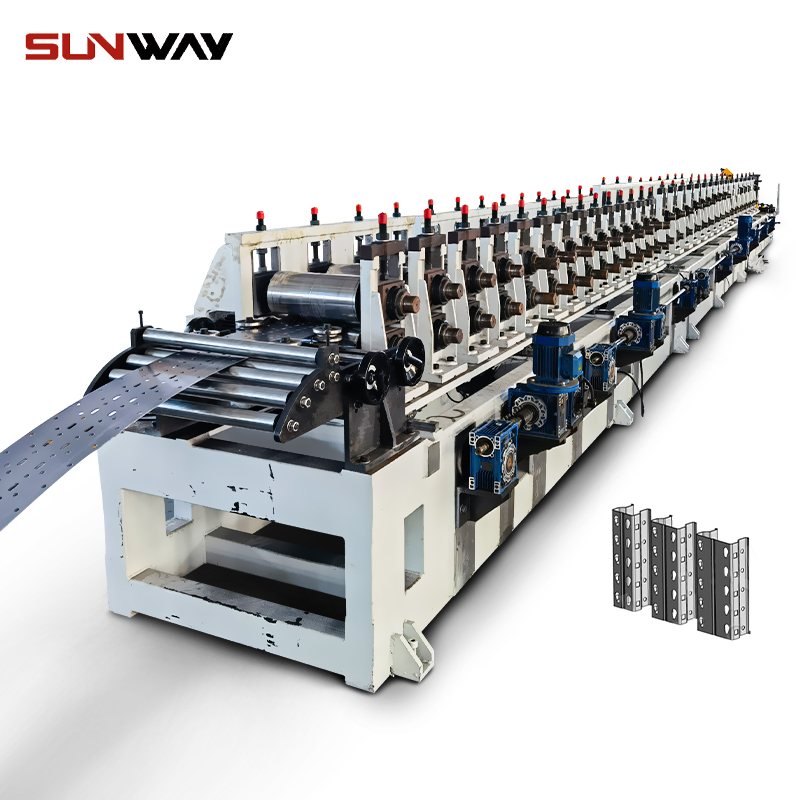
A Step Beam Roll Forming Machine—also known as a P-Beam Roll Forming Line or Rack Beam Forming Machine—is a specialized piece of industrial equipment designed for the continuous forming of step beams used in warehouse pallet racking systems. These beams, commonly referred to as "box beams" or "P-beams", serve as the horizontal load-bearing members in large-scale storage racks, ensuring structural strength, load stability, and safety for high-bay warehouse applications.

Modern step beam roll forming machines combine precision engineering, advanced control systems, and robust construction to deliver high-efficiency, high-accuracy production. Whether for heavy-duty warehouse racks, logistics centers, or industrial shelving systems, this machine is an essential part of the manufacturing process.


Key Features and Technical Advantages

1. Robust Structural Design

The step beam roll forming machine is built on a heavy-gauge welded steel frame that guarantees stability and durability during high-speed production. Each station is precisely machined to ensure accurate roll alignment, resulting in consistent product quality across every beam produced.

2. Wide Material Compatibility

It can process various types of steel coil, including:

  • Cold-rolled steel (CR)

  • Galvanized steel (GI)

  • Hot-rolled steel (HR)

  • Pre-painted steel (PPGI)

Typical material thickness ranges from 1.5 mm to 3.0 mm, suitable for manufacturing both standard and heavy-duty racking beams.

3. Precision Roll Forming Stations

The forming section usually includes 16 to 28 roll forming stations, depending on the profile complexity. Each roll set is made of high-grade GCr15 bearing steel, hardened and chrome-plated for long service life and dimensional stability.

4. High Production Speed

Modern step beam forming lines achieve speeds of 10 – 20 meters per minute, depending on material type and beam design. Combined with automatic feeding and cutting systems, it significantly increases output while maintaining tight tolerances.

5. Advanced Automation and Control

The line is controlled by a PLC (Programmable Logic Controller) system with a touchscreen HMI interface, allowing operators to input production parameters such as beam length, hole spacing, and quantity. Automatic cutting, punching, and size adjustments minimize downtime and ensure operational simplicity.

6. Precise Flying Cut System

A flying shear cutting system guarantees smooth and burr-free cuts without stopping the production line. Hydraulic or servo-driven shears ensure high cutting precision and extended blade life.

7. Optional Integrated Welding & Assembly

For box-type or double-C beam configurations, the machine can integrate automatic seam welding units, enabling direct formation of closed beams ready for powder coating or galvanization.


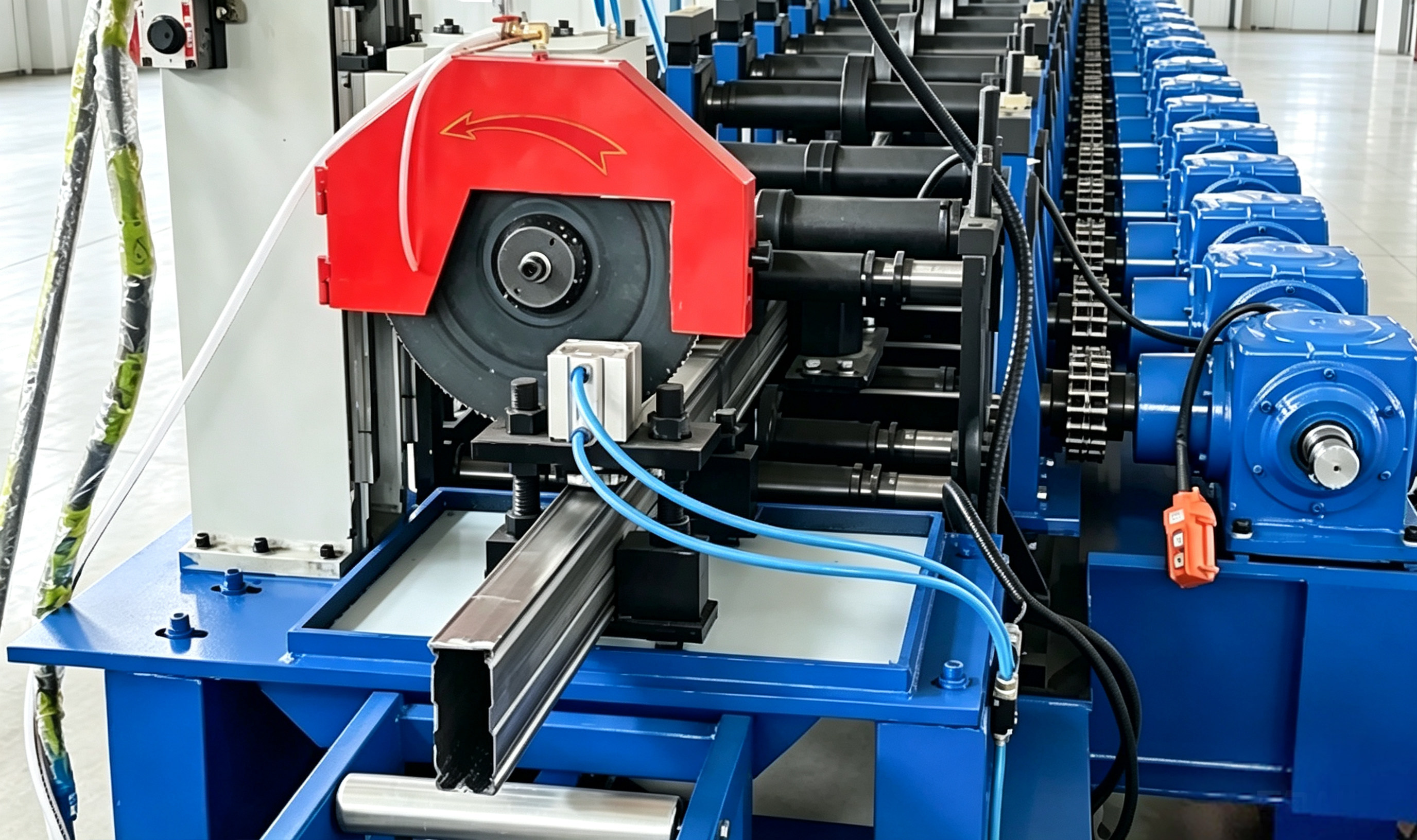
Cold saw cutting unit on Step Beam Roll Forming Machine ensuring burr-free ends for heavy-duty pallet racking

Production Process

  1. Decoiling – Steel coil is loaded onto an automatic uncoiler.

  2. Leveling & Feeding – Material is straightened and accurately fed into the forming section.

  3. Roll Forming – Progressive shaping through multiple stations gradually forms the step beam profile.

  4. Punching (Optional) – Holes or slots for beam connectors can be punched inline.

  5. Cutting to Length – A flying shear cuts the beam to precise lengths as programmed.

  6. Welding & Finishing (Optional) – If required, beams are automatically welded into box shapes and prepared for surface finishing.

  7. Output Table – Finished beams are collected and ready for inspection or packaging.


Applications

  • Heavy-duty pallet racking systems

  • Industrial shelving and mezzanine floor structures

  • Automated storage and retrieval systems (AS/RS)

  • Cold storage warehouse racks

  • Logistics and distribution center shelving

The step beam produced by this machine features excellent load-bearing capacity, dimensional accuracy, and smooth surface finish, making it ideal for modern warehouse infrastructure.


Advantages for Manufacturers

  • High Efficiency: Continuous automated production ensures high throughput and minimal waste.

  • Low Operating Cost: Reduced manual intervention lowers labor expenses and improves consistency.

  • Flexible Customization: Quick changeover between different beam sizes using modular roll tooling or automatic adjustment systems.

  • Superior Product Quality: Perfect forming accuracy ensures proper fit with upright frames and beam connectors.

  • Longevity & Reliability: Premium components such as SKF bearings, Siemens or Mitsubishi PLC, and hardened rollers ensure years of maintenance-free operation.

Why Choose a Professional Step Beam Roll Forming Line

Choosing a specialized manufacturer ensures that every part of the line—from the decoiler to the cutting unit—is optimized for rack beam production. Compared with generic roll forming equipment, a dedicated step beam forming line offers:

  • Better beam shape consistency

  • Higher load rating accuracy

  • Faster profile switching

  • Easier integration with welding and powder coating systems

Leading suppliers (such as those based in China, Europe, and the U.S.) provide complete turnkey solutions, including on-site installation, operator training, and after-sales service.


FAQ

1. What is the typical production rate of a step beam machine?
Production speeds range from 100 to 300 feet per minute (30–90 meters/minute), depending on material type, thickness, and profile complexity.

2. Can step beam machines produce curved profiles?
Primarily designed for straight sections, some machines can integrate additional forming units to create gentle curves or radii, though they are not a substitute for dedicated bending machines.

3. How often should roll tooling be replaced or serviced?
Tooling longevity depends on material type and production volume. Regular inspection, cleaning, and preventive maintenance can significantly extend tool life and maintain consistent forming accuracy.

4. Can step beam machines handle different material thicknesses?
Yes. Most systems accommodate thicknesses from 0.5 mm (0.020”) up to 6 mm (0.25”), depending on design and machine power.

5. How are custom roll tools designed?
Custom tooling is created using CAD/CAM software to model the target profile and optimize roll geometry. Prototyping or simulation ensures dimensional accuracy before full-scale production.

6. What safety measures should operators follow?
Operators must use machine guards, wear PPE (gloves, safety glasses, boots), follow lockout/tagout procedures, and undergo regular training. Preventive maintenance and adherence to safety standards are essential to minimize risks.

Conclusion

The Step Beam Roll Forming Machine is the backbone of modern warehouse rack manufacturing. Its advanced automation, high-precision forming capability, and durability make it indispensable for companies producing heavy-duty pallet racking systems.

By investing in a high-quality step beam roll forming line, manufacturers can achieve superior production efficiency, consistent product quality, and long-term profitability in the rapidly expanding logistics and warehousing industry.