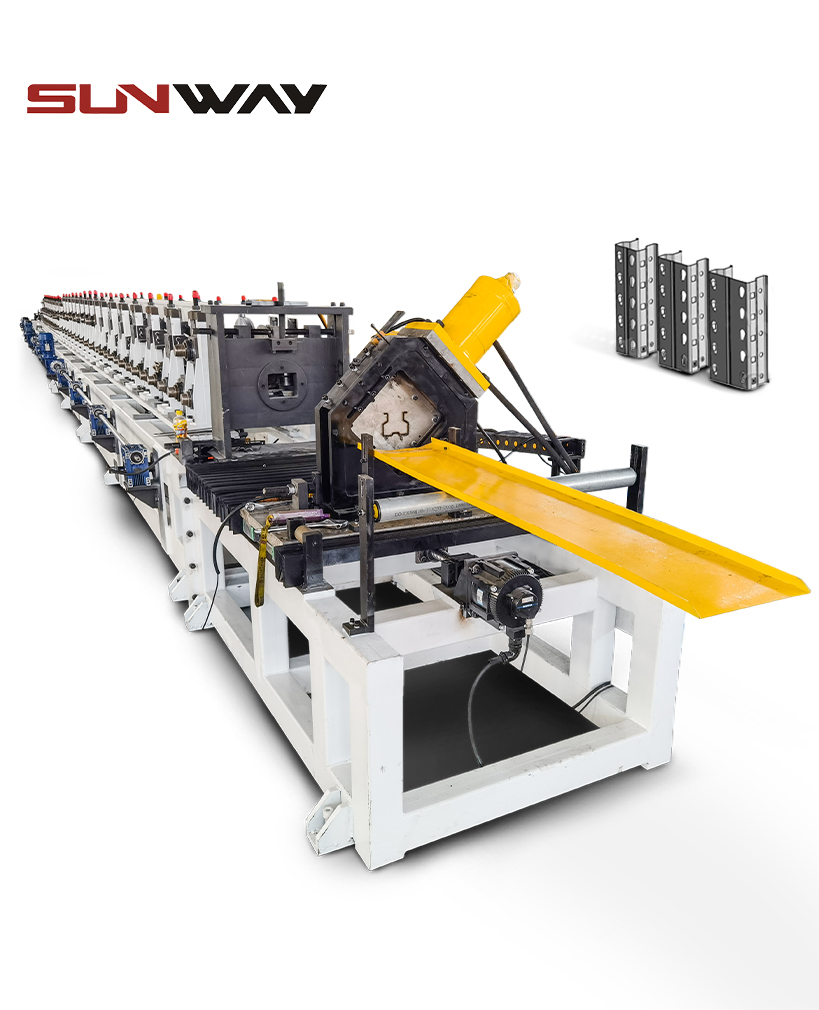
Complete Guide to Step Beam Roll Forming Machines for Warehouse Racking Manufacturers
Step Beam Roll Forming Machine: The Complete Guide for High-Efficiency Warehouse Racking Production
In the modern logistics and warehousing industry, pallet racking systems continue to evolve as businesses demand higher storage density, improved safety, and faster installation. At the heart of these storage systems lies the step beam, a critical load-bearing component that connects upright frames and supports pallet loads.
To meet large-scale industrial demand, manufacturers rely on an advanced, automated solution: the Step Beam Roll Forming Machine.
This comprehensive guide explores what the machine is, how it works, its components, benefits, applications, and what to consider when selecting a roll forming line for your factory.
What Is a Step Beam Roll Forming Machine?
A Step Beam Roll Forming Machine is a fully automated production line designed to manufacture step beams—also known as box beams or C-step beams—used in selective pallet racking systems. The machine uses a sequence of precision-engineered rollers to gradually bend and shape steel coils into the final beam profile, followed by automated cutting and optional punching or welding.
The result is a high-strength, consistent, dimensionally accurate beam that meets warehouse racking standards.
Why Step Beams Matter in Pallet Racking Systems
Step beams are structural elements that connect right and left uprights while supporting pallet loads. Their characteristic “step” structure allows decking boards or wire mesh panels to rest securely on the beam.
Key advantages include:
-
High load-bearing capacity
-
Easy installation and replacement
-
Compatibility with most pallet types
-
Modular design for scalable warehouse configurations
Because step beams directly determine the safety and performance of the racking system, precision in their manufacturing is essential—hence the need for an advanced roll forming solution.
How a Step Beam Roll Forming Machine Works
A step beam roll forming line integrates several automated systems into one continuous production process. Below is a breakdown of its workflow.
The process begins with the uncoiler feeding steel coils into the production line.
Modern systems offer:
-
Hydraulic expansion
-
Automatic tension control
-
Coil loading carts
-
Optional double-head designs for uninterrupted production
A precision leveler removes coil curvature while servo feeders ensure accurate feeding into the forming section. Stable feeding is crucial for beam dimensional consistency.
This is the core section of the machine. A series of hardened steel rollers gradually bend the metal into the desired shape. Depending on beam design, a line may include:
-
16–28 forming stations
-
Quick-change roller cassettes
-
Shaft diameters ranging from 60–90 mm
-
High-rigidity gearbox or chain-drive transmission
These stations create the signature “step” and boxed-in strength structure of the beam.
Many step beams require end-connector slots or special shapes to fit beam brackets.
Optional additions include:
-
Hydraulic punching units
-
Servo punching dies
-
Automatic connector forming machines
-
Robot welding units
Two main cutting methods are used:
-
Ideal for high-speed production
-
Ensures continuous operation without stopping the line
-
Suitable for thicker materials
-
Provides clean and accurate edges
Cutting tolerances typically remain within ±1.0 mm.