


Automated Roll Forming Systems: Turnkey Production Solutions for Industrial Racking
July 15, 2026
The Era of Systemic Manufacturing in Industrial Racking
The global warehousing and logistics sector is undergoing a profound structural evolution. Modern distribution networks no longer source standalone racks; instead, they demand highly integrated, high-bay automated storage and retrieval systems (AS/RS). This systemic market transformation has completely reshaped the B2B procurement paradigm. For manufacturing plants, a buyer's primary concern has shifted from the initial cost of an isolated machine to a supplier's comprehensive volume delivery capacity. To secure high-value contracts with international logistics firms, factories must move past fragmented fabrication setups and implement a fully integrated, automated production environment tailored for heavy-duty shelf upright manufacturing.
In this fiercely competitive landscape, operational success is defined by overall plant efficiency. Relying on disconnected, labor-intensive stamping processes creates severe manufacturing bottlenecks, rendering your facility incapable of meeting rapid project deadlines. To stay ahead, forward-thinking enterprises are replacing individual machines with interconnected, turnkey production systems. Transitioning to a continuous manufacturing pipeline ensures that your facility can mass-produce ultra-precise structural columns, creating uniform metal shelf uprights that maintain strict structural integrity under massive loads.
Defining the Automated Roll Forming Solution for Industrial Racking
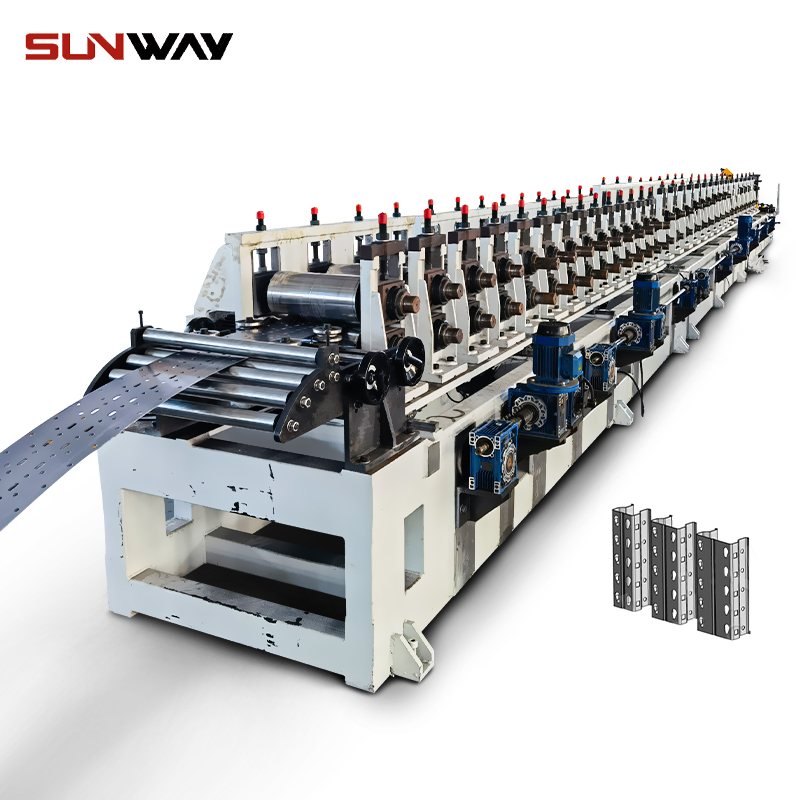
In high-volume B2B manufacturing, an automated roll forming solution represents much more than a standard set of rollers. From an advanced engineering perspective, it is a highly synchronized, turnkey production ecosystem engineered to transform raw steel coils into heavy-duty metal shelf uprights without manual material handling. The entire production line functions as a singular intelligent machine, coordinating advanced heavy-gauge metal leveling, continuous multi-axis mechanical or servo punching, precise cold geometric profiling, and automated discharge workflows.
This engineering integration layers every production step into a seamless process. By monitoring feed rates, material thickness fluctuations, and tool wear in real time, the integrated control system maintains perfect dimensional stability. When mass-producing complex structural profiles, this automated synchronization ensures that every single shelf upright matches its technical specifications precisely. This systemic consistency is vital for subsequent engineering phases, providing a flawless foundation for assembling robust, heavy-load metal shelf uprights and brackets.
Disjointed Processing vs. Integrated Automated Roll Forming Systems
To properly evaluate a capital expenditure investment, procurement managers must analyze the operational disparities between traditional workshop methods and unified production systems:
Traditional Segmented Setup: Raw sheets are cut, manually transported, and fed into individual press brakes. This fragmented workflow introduces significant material handling safety hazards, severe labor dependencies, and stacked tolerance errors. A minor positioning mistake during manual stamping can compromise an entire batch of metal shelf uprights.
Integrated Automated Solution: A raw steel coil is mounted on a heavy-duty decoiler, automatically leveled, punched, formed, and sheared in a single continuous operation. This configuration guarantees sub-millimeter structural tolerances, dramatically reduces human error, and delivers perfect mechanical alignment across all completed metal shelf uprights and brackets.
The Anatomy of a Turnkey Solution: Core Machinery within the Production Line
A modern, high-capacity production environment utilizes an array of specialized sub-systems to manufacture an industrial-grade shelf upright:
1.Smart Heavy-Duty Decoiler & Leveler: Efficiently handles massive steel coils up to 10 tons, removing material wave and coil memory to ensure a perfectly flat strip enters the active stamping zone.
2.Servo-Driven CNC Punching Array: Executes continuous, high-speed multi-axis hole patterns along the moving steel strip. This micro-precision ensures the finished shelf upright features perfect hook-and-slot spacing, allowing crossbeams to lock securely into place on-site.
3.Heavy-Duty Roll Forming Units: Engineered with robust cast-iron forming stands and solid alloy tool steel shafts. These units smoothly guide heavy-gauge steel into complex geometries, creating high-strength metal shelf uprights.
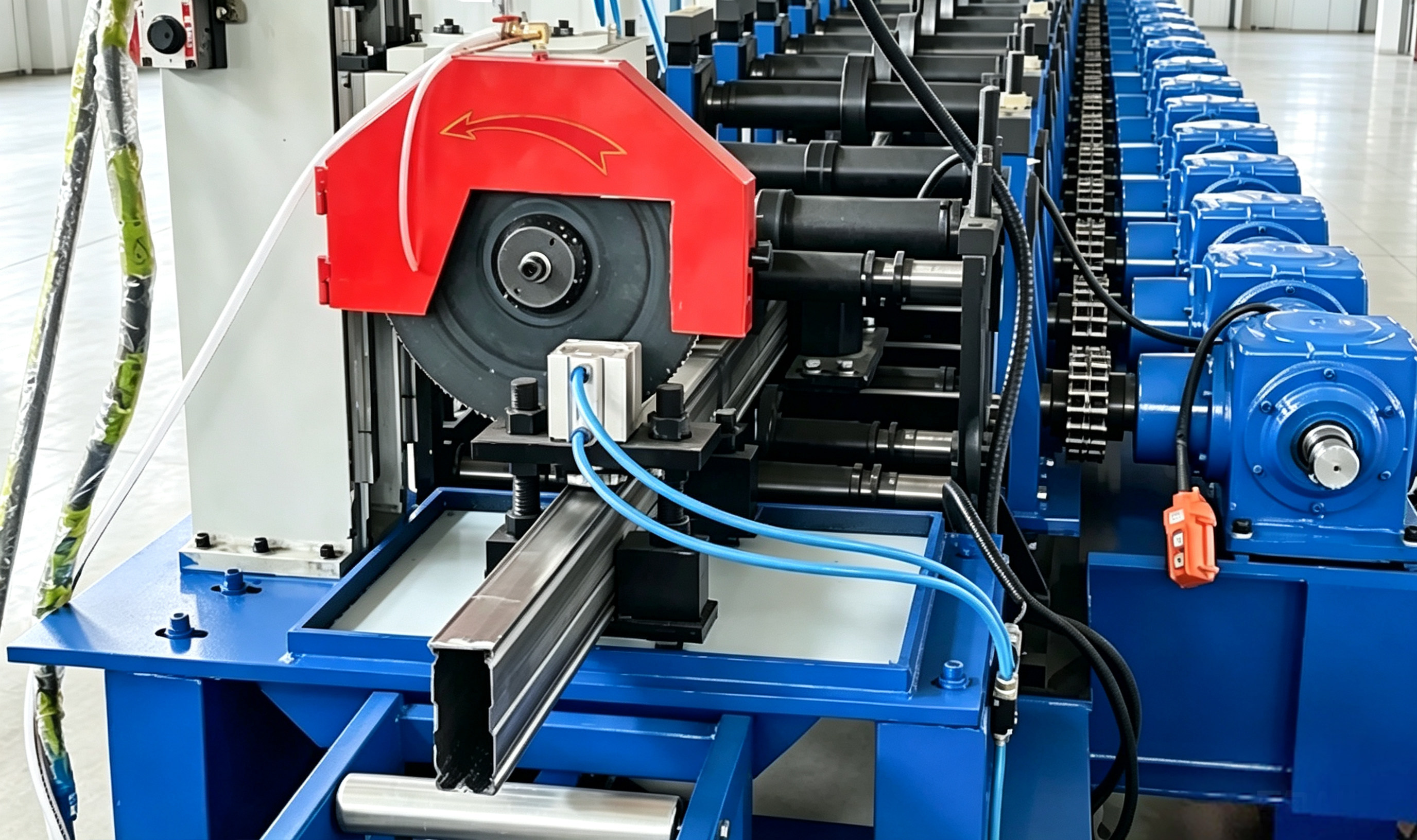
4.Post-Forming Automated Processing: Integrates flying tracking hydraulic shear mechanisms, secondary inline welding modules, or robotic stacking systems that instantly prepare the completed metal shelf uprights and brackets for global shipment.
Maximizing Plant Throughput: How Systemic Solutions Drive Factory Efficiency
Related News

2026-09-30 14
How to Select the Right Roll Forming Machine for Modern Warehouse Storage Racks
2026-09-22 18
How to Choose the Right Upright Rack Roll Forming Machine for Your Warehouse Racking Production?
2026-09-20 19
Precision Cold Roll Forming for Step Beam Pallet Racking & Shelving Systems