


How an Automated Roll Forming Line Eliminates Production Bottlenecks in Warehouse Racking Manufacturing
June 3, 2026
Entering the High-Velocity Era of Warehouse Racking Production
The global logistics, supply chain, and industrial warehousing sectors are undergoing a massive transformation. The rapid growth of mega e-commerce fulfillment hubs, automated cold-chain systems, and multi-tier Automated Storage and Retrieval Systems (ASRS) has driven the global demand for high-density warehouse storage systems to historic heights. However, this market growth presents a significant challenge for racking equipment fabricators. Modern distribution centers require structural profiles that exhibit high load-bearing capacities, strict dimensional tolerances, and exceptional structural consistency—all delivered under highly compressed project timelines.
This industrial environment creates a critical challenge for traditional manufacturing facilities. Relying on legacy workshop methods to fabricate heavy-duty racking columns, step beams, and shelf components creates substantial operational bottlenecks. Modern facilities require structural parts that are highly standardized to ensure compatibility with robotic material handling systems, yet flexible enough to accommodate custom profile specifications.
Faced with this changing market, traditional manufacturers must make an important strategic decision. Continuing with disjointed, manually operated machinery is no longer a viable way to scale. To protect profit margins and increase production output, leading global factories are rapidly phasing out individual sheet metal piecework. Instead, they are completely overhauling their facilities by integrating continuous engineering solutions. To manage this transition effectively, choosing a reliable partner that understands high-volume engineering standards has become an essential business objective.
The Hard Bottlenecks: What Is Killing Your Warehouse Racking Production Efficiency?
To understand why a factory-wide upgrade is necessary, it is essential to analyze the structural inefficiencies and hidden operational costs associated with legacy metal fabrication.
Process Fragmentation and Time Internal Waste
Traditional manufacturing methods typically rely on a segmented sequence: raw sheet metal sheets are first moved to a standalone station for shearing, manually transported to a separate station for punching, and then transferred again for bending. Every manual touchpoint represents a significant delay. The time spent waiting between stations, handling heavy profiles, and managing multiple equipment adjustments results in substantial internal waste, often consuming over 60% of effective production time on the shop floor.
Precision Deviations and High Field Rework Rates
Heavy-duty warehouse racking systems, especially those engineered for high-bay ASRS applications, require strict mechanical tolerances. Traditional manufacturing methods struggle with material spring-back and dimensional variance. When long-run upright profiles are processed across multiple disjointed machines, microscopic deviations accumulate. This leads to subtle twisting or hole misalignment along the vertical axis, creating severe assembly difficulties during final field installation and resulting in expensive on-site rework.
The Downtime Black Hole of Manual Changeovers
The modern racking market demands a vast array of product variations to fit different warehouse layouts. In a traditional production environment, switching tooling to accommodate a different profile size (such as adjusting an upright web width from 90mm to 120mm) requires hours of manual mechanical calibration. This lengthy changeover time creates a substantial production bottleneck, making it highly inefficient for factories to accept mid-sized custom orders.
Process Transformation: How Modern Machinery Rewrites the Racking Production Workflow
Implementing an automated continuous production line fundamentally changes the mechanics and economics of the factory floor. By choosing a partner equipped to optimize your machinery setup, you transition from slow, batch-based piecework to an advanced, high-efficiency manufacturing model.

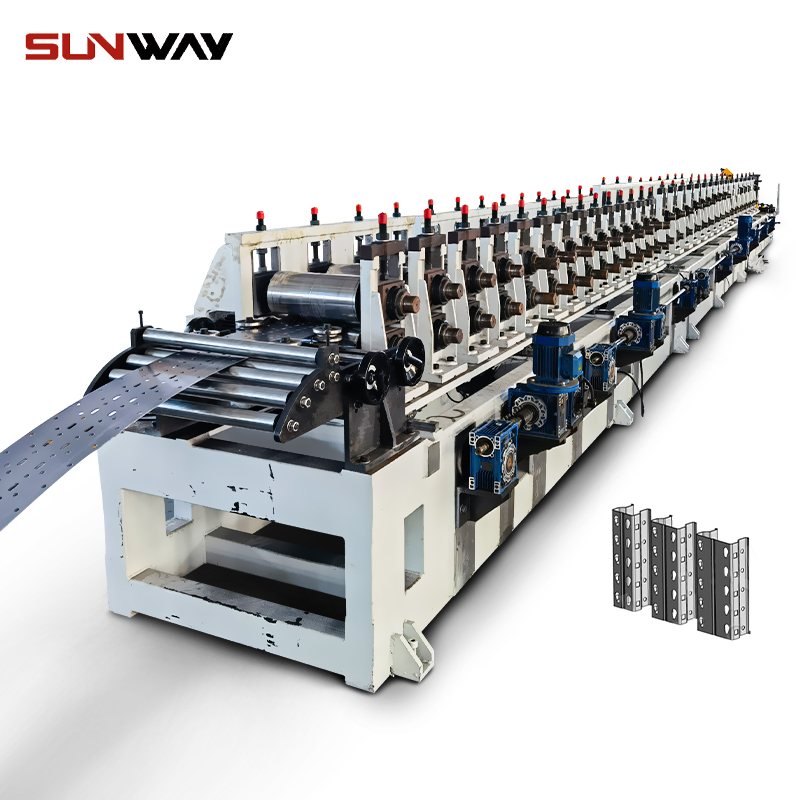
As a premier roll forming machine manufacturer, SUNWAY designs these advanced systems to unify diverse manufacturing actions into a single, non-stop automated matrix. The raw material moves seamlessly through the line without manual intervention, eliminating mid-process part accumulation and drastically reducing cycle times.
The core engineering advantage of this workflow lies in the integration of an advanced storage table loop system. Because punching requires a momentary pause (intermittent motion) while bending demands continuous movement (continuous motion), the deep material loop acts as a vital speed buffer. This sophisticated synchronization allows the entire line to run continuously at high speeds without inducing material stretching or structural deformation.
Mechanics of Speed: Key Mechanisms Enabling High-Efficiency Performance
To achieve exceptional manufacturing speeds while maintaining strict structural quality, a production line must utilize precisely engineered automation components. When choosing a partner for your roll forming machine manufacture needs, it is important to focus on the key sub-systems that drive operational throughput.
Dynamic Inline Servo Punching: Before the steel strip undergoes any bending, it passes through a high-tonnage hydraulic punching matrix. Controlled by high-precision servo drives, this system punches complex configurations—such as teardrop or butterfly slots—at exact intervals while moving at high speeds. This advanced inline processing eliminates positioning errors, ensuring perfect alignment before the profile is shaped.
Progressive Cold Deformation Stations: The heart of the system consists of a robust series of sequential rolling stands. A reliable roll forming machine manufacture process shapes the metal step-by-step through dozens of engineered roller pairs. This progressive deformation minimizes surface stress on the steel and induces a beneficial work-hardening effect, naturally increasing the material's yield strength.
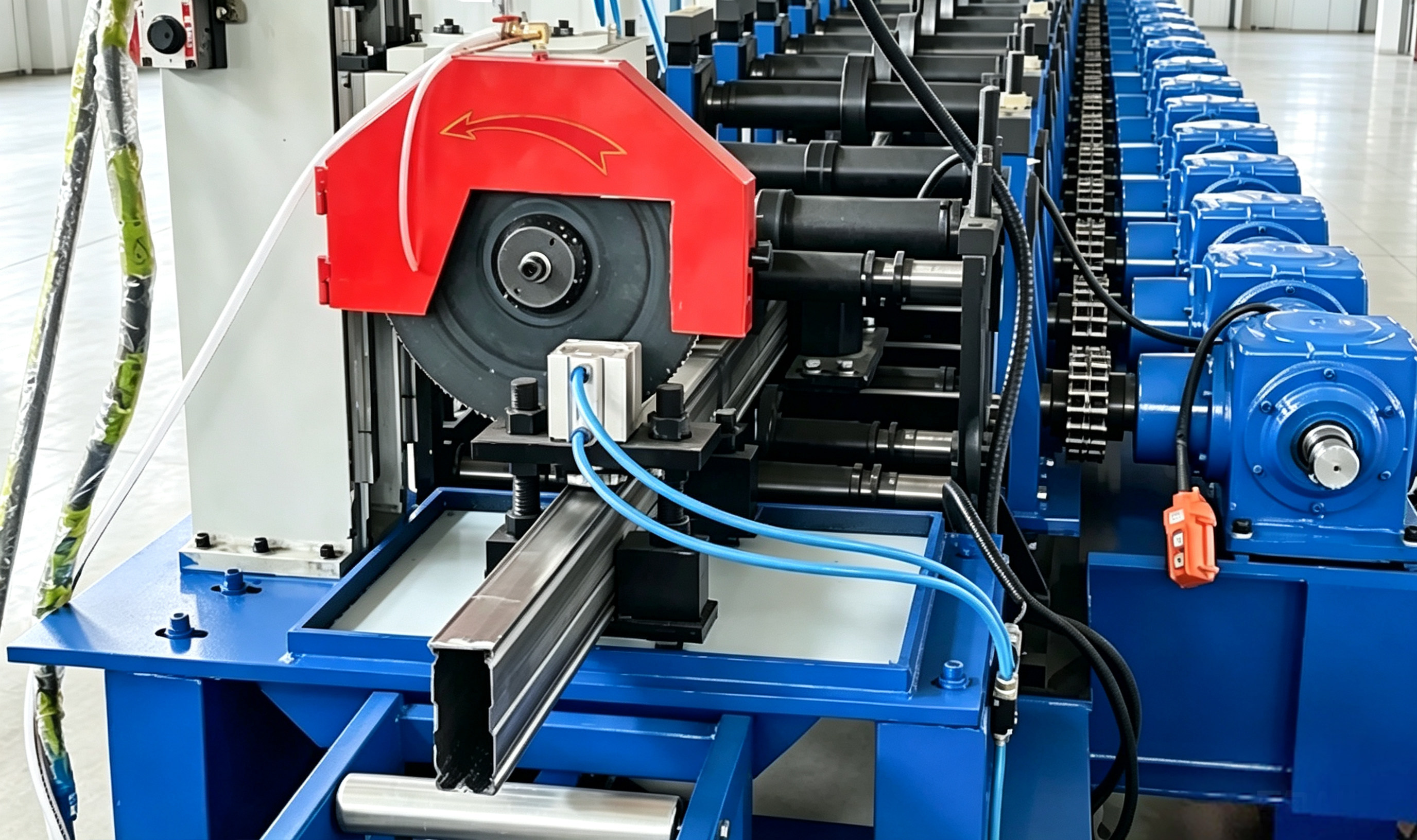
PLC Synchronized Central Control: Modern lines integrate all individual stations—from the decoiler to the flying shear—into a single centralized control network. Utilizing advanced PLC systems (such as Siemens), a single operator can monitor line speeds, adjust punch spacing, and manage cutting lengths via a simple touchscreen interface, simplifying complex factory operations.
Quantifiable Impact: Real-World Efficiency Gains in Racking Production
Upgrading your manufacturing facility with equipment from an established roll forming machine manufacturer yields immediate, measurable improvements across all primary production metrics:
|
Operational Performance Metric
|
Legacy Multi-Station Methods
|
SUNWAY Automated Production Line
|
|
Linear Output Capacity
|
1 - 2 meters per minute
|
15 - 25 meters per minute
|
|
Tooling Changeover Time
|
2 - 4 hours of manual labor
|
Under 10 minutes via PLC screen
|
|
Material Scrap Rate
|
5% - 8% due to manual cutting
|
Less than 1% via flying shear
|
|
Direct Labor Requirement
|
4 - 5 skilled machine operators
|
1 single automated line technician
|
By utilizing a specialized Duplex Roll Forming System or a Quick-Change Cassette System, width adjustments are handled automatically through the central controls. This zero-downtime changeover capability allows factories to seamlessly mix high-volume standard runs with specialized custom orders without sacrificing daily output.
Application Scenarios: Which Racking Components Benefit the Most?
An automated continuous manufacturing system provides the versatility required to produce a comprehensive portfolio of industrial storage components efficiently:

Warehouse Shelf Upright Racks: Automated production lines easily handle the strict structural requirements of main vertical columns. The system delivers the deep punching patterns and exceptional straightness standards necessary to build stable vertical structures up to 12+ meters for high-bay ASRS configurations.
Step Beams and Interlocking Box Beams: Supporting heavy, palletized inventory requires horizontal beams with exceptional torsional rigidity. Modern automated systems can roll form precision step profiles or continuously interlock dual C-channels into high-strength box configurations, ensuring uniform weld-ready seams.
High-Volume Box Plates and C-Bracing: Manufacturing flat storage decks and stabilizing bracing requires high-speed surface flattening and integrated structural stiffeners. An automated line fabricates these vital components at high speeds, ensuring consistent flat surfaces and precise connecting tabs.
Financial Justification: Why Efficiency Gains Directly Drive Bottom-Line Profits (ROI)
Investing in automated production lines represents a foundational strategic upgrade that significantly improves the financial performance of your manufacturing business.
Drastic Reduction in Direct Labor Expenses
Transitioning to an automated continuous production line significantly reduces your dependency on manual shop floor labor. A traditional manufacturing workflow requires four to five operators to manage individual machinery stations. An automated line compresses these steps into a single integrated system overseen by a single line technician. This substantial reduction in personnel costs allows your business to reallocate capital and recover its equipment investment rapidly.
Optimizing Floor Space and Work-in-Progress (WIP) Logistics
Traditional multi-machine manufacturing configurations require substantial factory floor space simply to store semi-finished materials waiting for the next fabrication step. An automated continuous line compresses multiple standalone manufacturing steps into a single integrated footprint. This lean setup eliminates internal transport bottlenecks and frees up valuable square footage within your facility for additional finishing or automated packaging lines.
Minimizing Raw Material Waste
With steel prices representing a significant portion of overall product manufacturing costs, minimizing scrap rates directly enhances profitability. Traditional manual shearing processes frequently generate drop-off waste and unusable tail ends on every sheet. An automated line utilizing synchronized inline flying shears cuts moving profiles to exact pre-programmed lengths, reducing material scrap rates to under 1%. This precise material optimization ensures your factory extracts maximum commercial value from every ton of raw structural steel.
Strategic Partnership: Aligning with a Leading Industry Pioneer
Successfully upgrading your production capabilities requires more than simply purchasing standard industrial machinery. It requires establishing a long-term technical partnership with an experienced system builder who understands the unique engineering challenges of heavy structural metal fabrication.
Among global cold roll forming machine manufacturers, Wuxi Sunway Machinery Co., Ltd. (SUNWAY) delivers deep engineering expertise directly to your facility. We don't just sell individual pieces of equipment; we design and deliver fully integrated, turnkey industrial manufacturing solutions.
From initial custom rolling die design and advanced automated control integration to comprehensive on-site installation, commissioning, and staff training, SUNWAY ensures your new production line achieves peak efficiency from day one. Choosing us as your dedicated partner means investing in a high-efficiency production asset built for long-term industrial reliability.
FAQ: Overcoming Executive Doubts Before Ordering
Q: Does high-speed roll forming damage the anti-corrosive coating of pre-galvanized coils?
A: No. As an experienced roll forming machine manufacturer, SUNWAY engineers its rolling tools from premium Cr12MoV die steel, which undergoes vacuum heat treatment and hard chrome plating. This ultra-smooth surface finish minimizes friction, protecting pre-coated or galvanized finishes even during high-speed continuous production.
Q: How long does it take for a complete line setup and engineering training?
A: The standard timeline from design approval to factory delivery ranges from 60 to 120 days. Once the machinery arrives at your facility, our expert technical team provides complete on-site installation, system commissioning, and comprehensive operator training to ensure immediate operational success.
A: The standard timeline from design approval to factory delivery ranges from 60 to 120 days. Once the machinery arrives at your facility, our expert technical team provides complete on-site installation, system commissioning, and comprehensive operator training to ensure immediate operational success.
Q: Can SUNWAY lines be integrated with automatic welding or robotic stacking systems later?
A: Absolutely. Our automated production systems are engineered with open-architecture PLC controls. This allows for seamless future expansion, enabling you to integrate robotic welding stations or automatic stacking systems downstream as your production needs grow.
A: Absolutely. Our automated production systems are engineered with open-architecture PLC controls. This allows for seamless future expansion, enabling you to integrate robotic welding stations or automatic stacking systems downstream as your production needs grow.
Related News

2026-09-28 8
How to Select the Right Roll Forming Machine for Modern Warehouse Storage Racks
2026-09-22 13
How to Choose the Right Upright Rack Roll Forming Machine for Your Warehouse Racking Production?
2026-09-20 16
Precision Cold Roll Forming for Step Beam Pallet Racking & Shelving Systems