


Why Warehouse Racking Manufacturers Must Transition to Automated Roll Forming Lines
May 27, 2026
The Industrial Metamorphosis of Warehouse Racking Fabrication
The global logistics landscape is undergoing an unprecedented technological transformation. Driven by the rapid expansion of mega e-commerce fulfillment hubs, automated cold-chain networks, and multi-tier Automated Storage and Retrieval Systems (ASRS), the global demand for structural storage systems has reached historic heights. However, this market growth presents a significant challenge for structural fabricators. Modern supply chain infrastructure demands warehouse racking profiles that exhibit exceptional load-bearing capacities, uniform metallurgical consistency, and strict dimensional tolerances—often required within remarkably compressed project delivery timelines.
This industrial shift forces global racking manufacturers to re-evaluate their production methodologies. Relying on legacy workshop methods to fabricate heavy-duty racking columns, step beams, and shelf panels creates significant operational bottlenecks. Modern distribution centers require structural components that are highly standardized to ensure compatibility with robotic material handling equipment, yet flexible enough to accommodate custom structural profiles.
Faced with this evolving landscape, legacy manufacturers must make a critical decision. Continuing with disjointed, manually operated machinery is no longer a sustainable business model. To protect profit margins and scale production capacities, leading global factories are rapidly phasing out individual sheet metal piecework. Instead, they are completely overhauling their facilities by integrating continuous engineering solutions. To successfully manage this transition, partnering with an established partner that can seamlessly supply roll forming machine configurations customized for heavy-duty profiles has become a vital strategic imperative.
The Profit Killers: Limitations and Risks of Traditional Racking Manufacturing Methods
To understand why a factory-wide upgrade is necessary, it is essential to analyze the structural inefficiencies and hidden financial costs associated with traditional metal fabrication.
The Press Brake Bottleneck
For decades, standard hydraulic press brakes served as the primary tool for shaping heavy gauge sheet metal. However, in high-volume commercial manufacturing, press brakes present significant limitations. The process is inherently interrupted, requiring manual sheet feeding, individual piece clamping, and multi-stage handling for every single bend. When fabricating specialized 12-meter-long upright columns for high-bay ASRS configurations, standard press brake beds fall short. Forcing multiple long-run sections to be joined together introduces structural vulnerabilities, increases assembly labor costs, and often leads to subtle deviations in straightness along the vertical axis.
The Material Spring-Back and Hole Misalignment Problem
Traditional manufacturing methods typically rely on a segmented sequence: raw sheet metal sheets are first moved to a standalone station for punching, and then manually transported to a separate station for bending. During this movement, structural steel naturally experiences variations in structural spring-back. When pre-punched flat sheets are subsequently bent on a press brake, the slight material shifting alters the precise alignment of the hole spacing. This microscopic variance creates significant alignment issues during final field installation, leading to delayed project completions and frustrated structural clients.
Escalating Labor Dependencies and Scrap Rates
Legacy production environments depend heavily on highly skilled machinery operators to manually handle heavy structural blanks. As labor costs continue to rise globally and skilled metalworkers become increasingly scarce, maintaining a multi-operator production line significantly erodes factory profitability. Furthermore, moving heavy steel sections between individual machines increases the risk of surface scratching and material handling damage. This multi-step process typically results in material scrap rates of 5% to 8%, creating an ongoing waste of raw material.
Paradigm Shift: How Roll Forming Completely Rewrites Racking Production Logic
Implementing an automated continuous production line fundamentally changes the mechanics and economics of the factory floor. By choosing a partner equipped to optimize your machinery setup, you transition from slow, batch-based piecework to a continuous, high-efficiency manufacturing model.
Transforming Intermittent Steps into a Continuous Flow
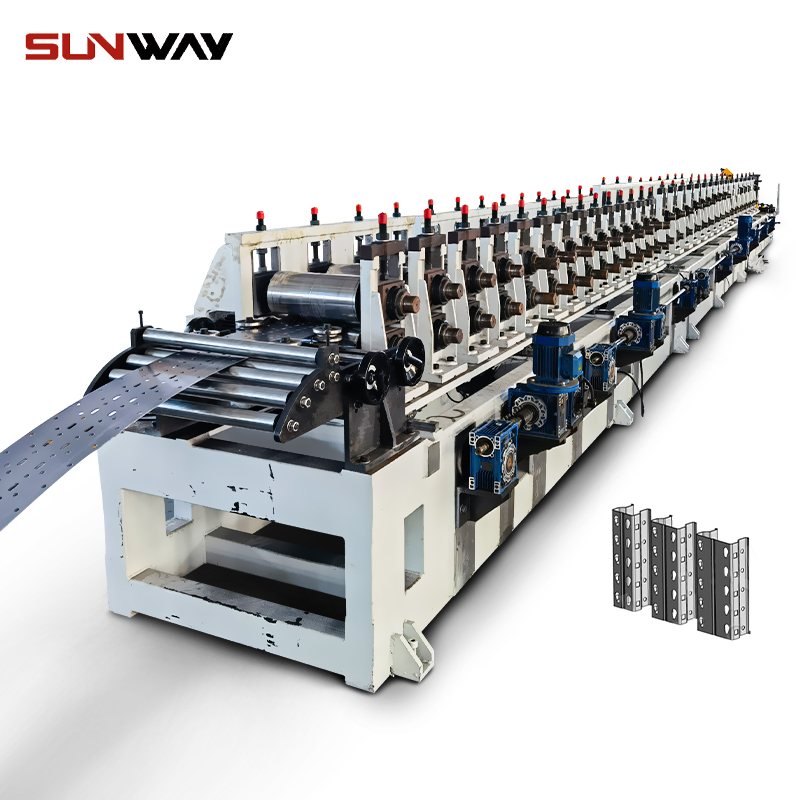
The core engineering advantage of a modern continuous production line lies in its ability to unify diverse manufacturing actions into a single, non-stop automated matrix. Utilizing a highly synchronized storage table and looping mechanism, the line effortlessly balances the momentary stop needed for high-tonnage hydraulic punching with the continuous movement required for progressive cold bending. The raw steel moves seamlessly through the line without manual intervention, eliminating mid-process part accumulation and drastically reducing cycle times.
Capitalizing on Material Work-Hardening
Unlike sudden press brake bending, which can strain structural steel along the bend radius, progressive cold rolling bends the material gradually across dozens of sequential roller stands. This gentle, multi-stage deformation induces a beneficial metallurgical phenomenon known as work-hardening. As the steel passes through successive engineered rollers, its mechanical yield strength naturally increases. This allows a roll forming machine supplier like SUNWAY to design lighter, material-optimized profiles that achieve or exceed the load capacities of thicker, traditionally fabricated profiles, offering long-term raw material cost savings.
Achieving Sub-Millimeter Geometric Accuracy
Modern continuous production lines utilize closed-loop Programmable Logic Controllers (PLC) paired with high-speed servo-driven tracking systems. Whether running a standard three-meter rack or an intensive twelve-meter column, the automated system controls linear and rotational tolerances to within ±0.5mm. This continuous precision ensures that every interlocking slot, butterfly hole, and bracing connection aligns perfectly during field assembly, minimizing on-site modifications.
Technical Breakdown: Core Advantages of Integrating Roll Forming Lines
When evaluating your long-term manufacturing strategy, it is beneficial to analyze the specific capabilities provided by an industrial-grade production line. As a specialized manufacturer focused on engineering advanced configurations, SUNWAY transforms these technical concepts into reliable, high-yield manufacturing machinery.
[Raw Structural Steel Input] → [Automated Multi-Stage Bending] → [Precise Servo Punching] → [Finished Structural Profiles]
High-Volume Continuous Scalability
A premier production line operates at continuous manufacturing speeds ranging from 15 to 25 meters per minute, even while executing complex inline punching sequences. A single automated line can generate more finished structural components in a single shift than a series of individual traditional press brakes working simultaneously. This massive increase in output capacity enables your factory to confidently bid on large-scale logistics hub contracts that demand rapid delivery.
One-Step Processing of Highly Complex Cross-Sections
Modern structural upright designs often incorporate intricate multi-bend geometries, such as the high-strength Omega profile, featuring over twenty distinct geometric bends and return flanges. Achieving these complex configurations on a standard press brake requires a highly inefficient multi-pass setup. A specialized automated line handles these complex cross-sections in a single pass.
For factories looking to diversify their capabilities, partnering with an experienced manufacturer that can supply roll forming machine configurations equipped with a quick-change cassette system allows for rapid transitions between uprights, box beams, and shelf panels with minimal setup downtime.
The Importance of Sourcing from a Dedicated Machine Builder
Maximizing the return on your factory investment depends heavily on the engineering depth of your equipment partner. A generic machinery middleman cannot provide the tailored solutions required for heavy structural steel fabrication. Working with an experienced roll forming machine supplier ensures that your system frame is constructed from solid, vibration-dampening cast iron or thick-walled welded steel plates. Heavy structural profiles require robust, oversized drive shafts, hardened universal joints, and precisely engineered gearboxes to handle high-yield structural steel without experiencing mechanical fatigue or frame deflection.
Financial Justification: Calculating the ROI of a "Production-Line Level" Upgrade
Investing in an automated manufacturing line represents a foundational strategic upgrade that significantly improves the financial performance of your business.
Optimizing Floor Space and Streamlining Shop Floor Logistics
Traditional multi-machine manufacturing configurations require substantial factory floor space simply to store semi-finished materials waiting for the next fabrication step. This constant intra-factory transport clutters floor space and increases material handling risks. An automated line compresses multiple standalone manufacturing steps into a single integrated footprint. This lean footprint frees up valuable square footage within your facility, allowing you to optimize shop floor logistics or allocate space for additional powder coating or automated packaging stations.
Substantial Labor Cost Savings
Transitioning to an automated continuous production line drastically reduces your dependency on manual shop floor labor. A traditional manufacturing workflow requires five to six operators to manage shearing, punching, moving, and bending individual components. A fully automated continuous line requires only one technician to oversee the main PLC control panel, manage raw material coil loading, and monitor output quality. The resulting reduction in direct labor costs allows your business to recover a significant portion of its machinery investment within the first year of operation.
Minimizing Raw Material Waste
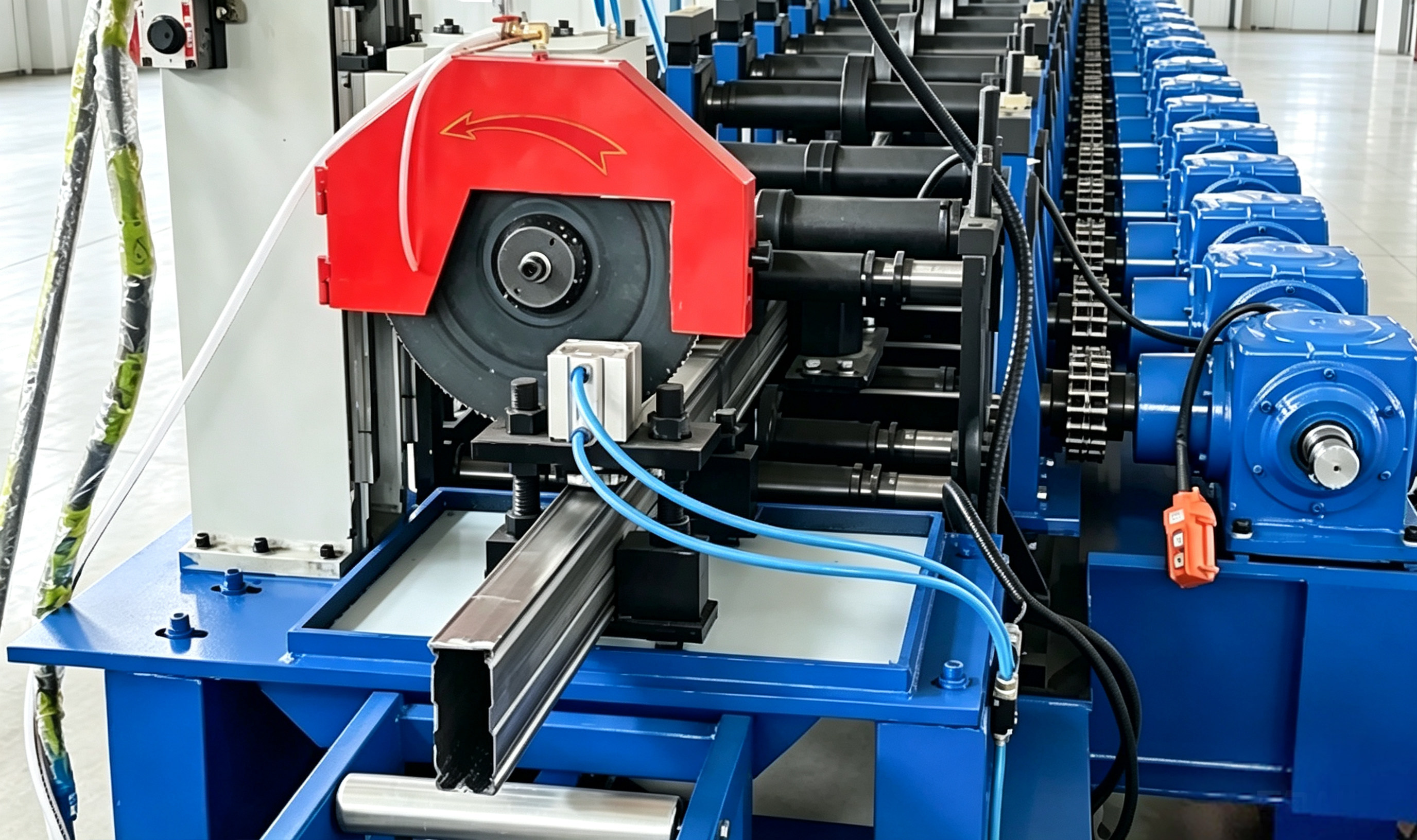
With steel prices representing a significant portion of overall product manufacturing costs, minimizing scrap rates directly enhances profitability. Traditional manual shearing processes frequently generate drop-off waste and unusable tail ends on every sheet. An automated line utilizing synchronized inline flying shears cuts moving profiles to exact pre-programmed lengths, reducing material scrap rates to under 1%. This precise material optimization ensures your factory extracts maximum commercial value from every ton of raw structural steel.
Application Scenarios: Where Does the Roll Forming Advantage Manifest Most?
An automated manufacturing system provides the versatility required to produce a comprehensive portfolio of warehouse storage components:

Heavy-Duty Upright Racks and C-Bracing: Automated production lines easily handle the intensive structural requirements of main vertical columns and stabilizing cross-bracing. The system delivers the deep punching patterns and strict straightness standards necessary to build stable vertical structures.
Step Beams and Interlocking Box Beams: Supporting heavy, palletized inventory requires horizontal beams with exceptional torsional rigidity. Modern automated systems can roll form precision step profiles or continuously interlock dual C-channels into high-strength box configurations, ensuring uniform weld-ready seams.
High-Volume Box Plates and Shelf Panels: Manufacturing flat storage decks requires high-speed surface flatting and integrated structural stiffeners. An automated line fabricates wide panels at high speeds, ensuring consistent flatness across large surfaces.
To stay competitive across these diverse applications, it is essential to align your business with a partner that can provide a reliable, long-term roll forming machine supply of custom-engineered tooling and automated machinery configurations.
Strategic Partnership: Aligning with a Visionary Roll Forming Supplier
Successfully upgrading your production capabilities requires more than simply purchasing standard industrial machinery. It requires establishing a long-term technical partnership with an experienced system builder who understands the unique engineering challenges of heavy structural metal fabrication.
Wuxi Sunway Machinery Co., Ltd. (SUNWAY) delivers over a decade of dedicated engineering and manufacturing expertise directly to your facility. We don't just sell individual pieces of equipment; we design and deliver fully integrated, turnkey industrial manufacturing solutions. From initial custom rolling die simulation and advanced automated control integration to comprehensive on-site installation, commissioning, and staff training, SUNWAY ensures your new production line achieves peak efficiency from day one.
When your business requires an experienced partner to supply roll forming machine configurations designed to handle demanding industrial schedules, SUNWAY provides the engineering precision, manufacturing durability, and global technical support your business needs to scale effectively.
8. FAQ: Addressing Executive Doubts Before the Transition
Q: Can an automated roll forming line efficiently handle smaller, customized product orders?
A: Yes. Modern lines designed by an established roll forming machine supplier like SUNWAY can be equipped with advanced duplex roll forming systems or quick-change tooling cassettes. These systems allow operators to quickly and automatically adjust the width and depth of the target profiles via the PLC touchscreen interface, making mid-sized custom production runs highly profitable.
A: Yes. Modern lines designed by an established roll forming machine supplier like SUNWAY can be equipped with advanced duplex roll forming systems or quick-change tooling cassettes. These systems allow operators to quickly and automatically adjust the width and depth of the target profiles via the PLC touchscreen interface, making mid-sized custom production runs highly profitable.
Q: How does the system protect pre-galvanized or painted steel finishes from surface scratching during high-speed rolling?
A: Our custom-engineered forming rollers are precision-machined from premium Cr12MoV die steel, subjected to rigorous vacuum heat treatments, and finished with a durable hard chrome plating. This ultra-smooth surface finish minimizes friction, protecting pre-coated or galvanized finishes even during high-speed continuous production.
A: Our custom-engineered forming rollers are precision-machined from premium Cr12MoV die steel, subjected to rigorous vacuum heat treatments, and finished with a durable hard chrome plating. This ultra-smooth surface finish minimizes friction, protecting pre-coated or galvanized finishes even during high-speed continuous production.
Q: What specific facility infrastructure is required to install an automated integrated production line?
A: A standard heavy-duty continuous line requires a flat, reinforced concrete foundation capable of supporting heavy structural machinery loads, an adequate industrial electrical supply to power the primary hydraulic stations and servo motors, and sufficient clear length to accommodate the continuous workflow. Our engineering team provides detailed foundation layouts and utility specifications well in advance to ensure a smooth, efficient installation process.
A: A standard heavy-duty continuous line requires a flat, reinforced concrete foundation capable of supporting heavy structural machinery loads, an adequate industrial electrical supply to power the primary hydraulic stations and servo motors, and sufficient clear length to accommodate the continuous workflow. Our engineering team provides detailed foundation layouts and utility specifications well in advance to ensure a smooth, efficient installation process.
Related News

2026-09-28 8
How to Select the Right Roll Forming Machine for Modern Warehouse Storage Racks
2026-09-22 13
How to Choose the Right Upright Rack Roll Forming Machine for Your Warehouse Racking Production?
2026-09-20 16
Precision Cold Roll Forming for Step Beam Pallet Racking & Shelving Systems