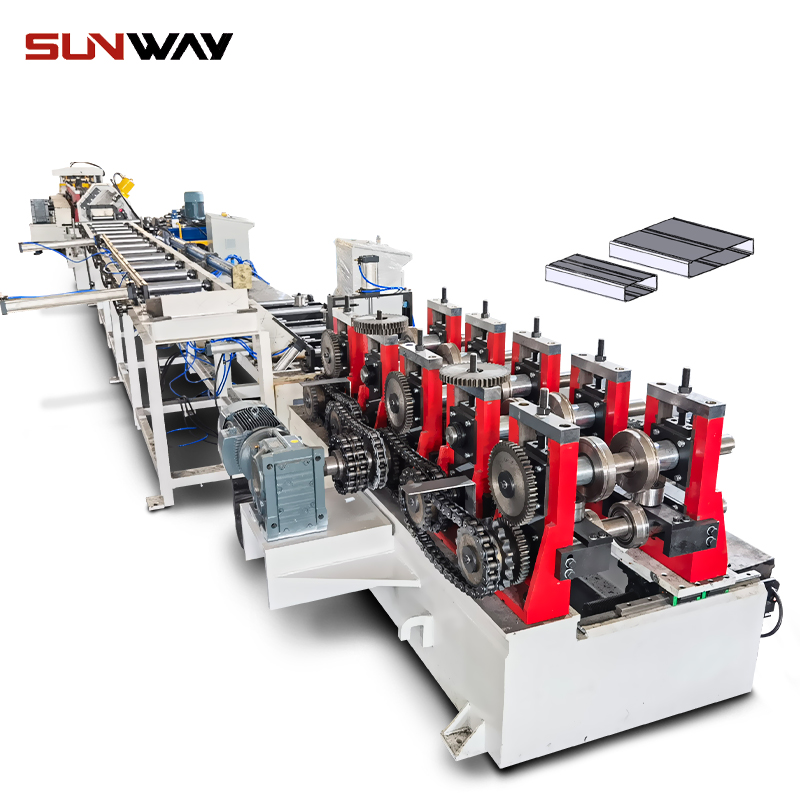
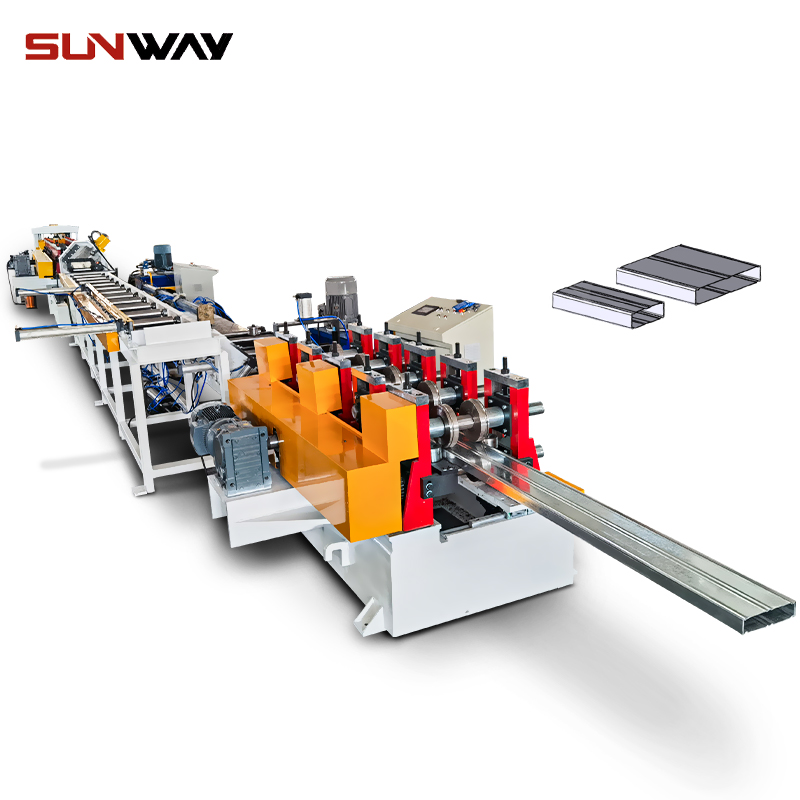
Solving Pitch Accumulation Error & Material Twisting in Heavy-Duty Upright Rack Roll Forming: An Engineer's Deep Dive
October 21, 2026
In modern logistics and high-bay warehousing, pallet racking systems are engineered to bear tens of tons across soaring elevations of 10 to 18 meters. At the core of every reliable racking frame lies the vertical column—the upright rack post.
For manufacturers operating a warehouse shelf upright rack roll forming machine, producing posts for high-load or automated storage and retrieval systems (AS/RS) presents severe manufacturing challenges. Two recurring defects account for the majority of rejected batches and installation failures: hole pitch accumulation errors and material twisting or camber in thick structural steel.
When an upright column deviates by even 1.5 mm over a 12-meter span, beam connectors will not hook properly, shelf levels lose alignment, and structural integrity is compromised. This guide examines the engineering principles required to eliminate these defects and achieve tight manufacturing tolerances on your roll forming production line.
The Root Causes of Pitch Accumulation Error in Post Punching
In upright column manufacturing, holes (such as teardrop, butterfly, diamond, or hex patterns) must align precisely along the entire length to accommodate step beams and bracing sections. Pitch accumulation error occurs when tiny dimensional variances between individual hole sets multiply over successive cycles.
The primary factors driving punching inaccuracy include:
1.Mechanical Slippage in Traditional Friction Feeders: Standard mechanical feed rollers without closed-loop feedback often slip on oily coiled steel, leading to micro-displacements on every stroke.
2.Material Tension & Elastic Elongation: Coiled steel (typically Q235B or high-strength Q355B/Grade 50) experiences fluctuating tensile resistance as it uncoils and passes through the straightener.
3.Decoupled Line Speed & Punch Cycle: In stop-and-go hydraulic punch presses, inconsistent brake response times introduce random pitch variances.
The Engineering Solution: Closed-Loop CNC Servo Punching
To maintain a pallet rack post roll forming machine tolerance of less than ±0.15 mm per pitch and an accumulated deviation below ±0.5 mm per 10 meters, modern production lines utilize CNC servo-driven punching units paired with high-resolution rotary optical encoders.
In an optimized system:
1.High-torque servo motors feed the strip with sub-millimeter precision directly into multi-station hydraulic punching dies.
2.A dedicated tracking measuring wheel rests directly on the moving strip, constantly relaying real-time position data back to the central PLC.
3.Hydraulic punching blocks incorporate hardened guide pillars and precision die sets machined from Cr12MoV/D2 tool steel, ensuring clean cutouts without burrs or deformed hole edges.
Overcoming Camber, Bow, and Twisting in Thick Structural Steel (2.0 mm – 3.5 mm)
Forming an upright column profile is significantly more complex than standard roll forming profiles. Heavy-duty uprights feature multiple bends, stiffening ribs, and return flanges formed from 2.0 mm to 3.5 mm thick hot-rolled or galvanized steel.
As high-yield material undergoes cold plastic deformation, severe residual stresses build up. Without proper tooling design, these stresses release unevenly, causing:
Camber (Side Bow): Curving along the profile's lateral edge.
Bow (Vertical Sag): Curvature along the vertical axis.
Twisting (Torsion): Rotational distortion along the column’s centerline.
1. Progressive Forming Passes & Flower Pattern Optimization
A common manufacturing mistake is attempting to shape heavy-gauge uprights using too few forming stations (e.g., 14 to 18 passes). Rapid angle changes force localized elongation, resulting in edge waves and permanent twisting.
An industrial-grade heavy duty upright column roll forming design requires 22 to 26 forming passes. By limiting the bending increment to just 2.5° to 4° per pass, internal bending stresses are distributed evenly across the profile cross-section.
2. High-Rigidity Cast Iron / Solid Memorial Arch Stands
Heavy structural profiles generate immense radial separation forces. Lightweight cantilevered stands flex under load, altering roll gaps and causing inconsistent profiles. Heavy-duty upright machines must be built on solid memorial arch-frame cast stands or precision-machined heavy steel plate housings to lock roll shafts in permanent alignment.
3. Precision Turk’s Head Straightening Mechanism
To ensure that post straightness meets the standard of ≤ 1.0 mm per meter, a four-axis multi-directional Turk’s head straightener is installed after the final calibration stations. Equipped with micro-adjustable side and vertical leveling rollers, this unit neutralizes any remaining residual torsional stresses before flying hydraulic cut-off.
Key Technical Specifications for Upright Machine Evaluation
When evaluating a new machine for your warehouse racking production, verify these technical parameters during factory acceptance testing:
| Technical Parameter | Standard Commercial Grade | SUNWAY Heavy-Duty Engineering Grade |
| Material Thickness Range | 1.5 mm – 2.5 mm | 1.8 mm – 3.5 mm (High-Tensile Steel) |
| Hole Pitch Accuracy | ± 0.3 mm / pitch | ± 0.15 mm / pitch (Servo Closed-Loop) |
| Cumulative Pitch Deviation | ± 1.5 mm / 10 m | ≤ ± 0.5 mm / 10 m |
| Profile Straightness (Bow/Camber) | ≤ 2.0 mm / m | ≤ 1.0 mm / m |
| Roll Tooling Material | GCr15 / 45# Steel | Cr12MoV / D2 (Vacuum Quenched HRC 58–62) |
| Forming Stations | 18 – 20 Stands | 22 – 26 Heavy-Duty Cast Stands |
Quality Tooling & Precision Manufacturing by SUNWAY
At Wuxi Sunway Machinery Co., Ltd. (brand: SUNWAY), we engineer dedicated roll forming equipment specifically for warehouse storage and logistics equipment manufacturers worldwide.
Our upright production lines feature:
1.Custom-engineered punching dies supporting standard teardrop, European omega, butterfly, and diamond profiles.
2.Roll tooling precision-machined on multi-axis CNC lathes and vacuum heat-treated to HRC 58–62, extending tooling lifespan past 15,000 tons of continuous production.
3.Advanced flying shear hydraulic cut-off systems that slice formed profiles cleanly without deformation or burrs.
4.100% pre-shipment trial runs using client-supplied coil specifications, accompanied by complete coordinate-measuring inspection reports and video documentation.
Conclusion & Next Steps
Achieving high-precision upright post production requires a holistic engineering approach—combining servo-driven closed-loop punching, generous forming passes, rigid machine stands, and multi-axis straightening. Investing in precision equipment minimizes scrap rates, eliminates field installation bottlenecks, and safeguards structural safety in high-load storage systems.
Planning a new upright rack production line or looking to upgrade profile accuracy?
Contact the engineering team at SUNWAY to submit your DWG/PDF profile drawings for a comprehensive tooling feasibility analysis and customized equipment quotation.
Contact the engineering team at SUNWAY to submit your DWG/PDF profile drawings for a comprehensive tooling feasibility analysis and customized equipment quotation.