Precision Cold Roll Forming for Step Beam Pallet Racking & Shelving Systems
September 20, 2026
The Critical Role of Step Beams in Modern Storage Safety
In industrial warehousing and material handling, horizontal load beams are the primary load-bearing components that bridge vertical upright frames. Among various beam geometries, the step beam remains the dominant standard across global logistics infrastructure. Engineered with a specialized inner recess step, step beams support heavy pallets directly while seamlessly accepting wire decking, safety bars, and drop-in steel panels.
Whether installed in high-density step beam pallet racking systems or modular step beam shelving units, these horizontal members endure severe static loads and dynamic forklift impacts. Substandard manufacturing—such as flange warping, out-of-square step angles, or premature beam deflection—can cause decking panels to dislodge, creating serious warehouse safety risks. Modern racking fabricators rely on advanced, automated step beam machine technology to produce high-capacity, structural-grade step beams that meet strict international safety standards.
Structural Dynamics: How Cold Roll Forming Dictates Step Beam Load Capacities
A step beam is an engineered structural assembly consisting of a multi-bend open or closed-C roll-formed section welded to heavy-gauge connector claws at both ends. The internal step feature—typically 1-1/2 inches or 2 inches deep—creates an interior ledge designed to seat decking flush with the top face of the beam.
Under full load, step beams experience combined bending moments and torsional shear stress. Continuous cold roll forming progressively shapes flat steel strip through sequential roller dies at ambient temperatures. This progressive deformation causes cold work hardening at each bend radius, increasing the yield strength of the steel along critical structural corners. As a result, roll-formed step beams deliver high strength-to-weight ratios, ensuring exceptional deflection resistance without adding unnecessary steel weight.
Engineering Precision: Solving the 3 Key Step Beam Manufacturing Hurdles
Manufacturing high-performance step beams requires overcoming complex metal-forming challenges. Precise dimensional control across three main areas determines whether a beam will pass structural inspection and assemble smoothly on site.
Hurdle 1: Absolute 90° Step Geometry & Recess Depth Precision
The defining feature of a step beam is its interior recess step. If the formed step angle deviates from a true 90-degree perpendicular corner or if the step depth varies along a 3.6-meter beam, wire decking and drop-in steel shelves will not seat flush. SUNWAY addresses this by engineering specialized calibrating roll passes that set exact 90-degree step radiuses within tight ±0.15mm tolerances, eliminating decking gaps or panel bowing.
Hurdle 2: High-Integrity Double-C Interlocking & Seam Stability
Heavy-duty step beams are formed by interlocking two C-channel sections or folding a continuous sheet into a closed, double-walled profile. Under heavy pallet loading, asymmetrical forces try to twist the beam open. Advanced roll tooling maintains uniform seam pressure during forming, ensuring that double-C interlocking joints remain tightly sealed and resist rotational twisting under maximum load ratings.
Hurdle 3: Longitudinal Straightness & Connector Weld Alignment
Longitudinal bow, camber, or twist in a roll-formed beam profile causes assembly issues during end-connector welding. If the beam body is twisted, automated robotic welding stations cannot align the end-connector claws perpendicular to the beam axis. Installing a multi-axis 3D Turk's Head unit at the exit of the roll forming line neutralizes internal residual stresses, delivering straight profiles that simplify robotic welding and ensure level beam placement on site.
Machine Architecture: Inside a High-Performance SUNWAY Step Beam Machine Line
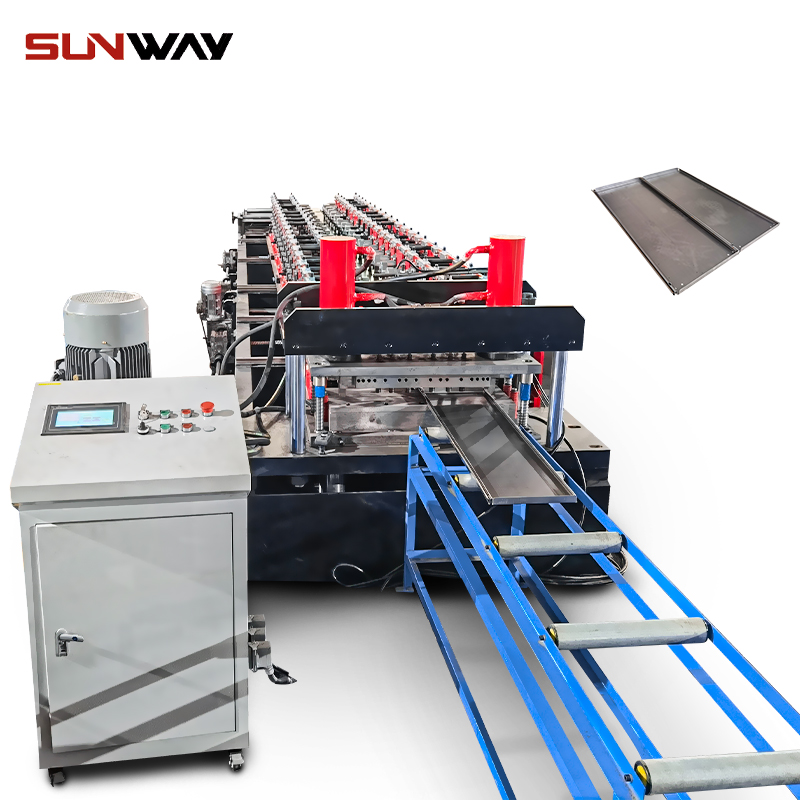
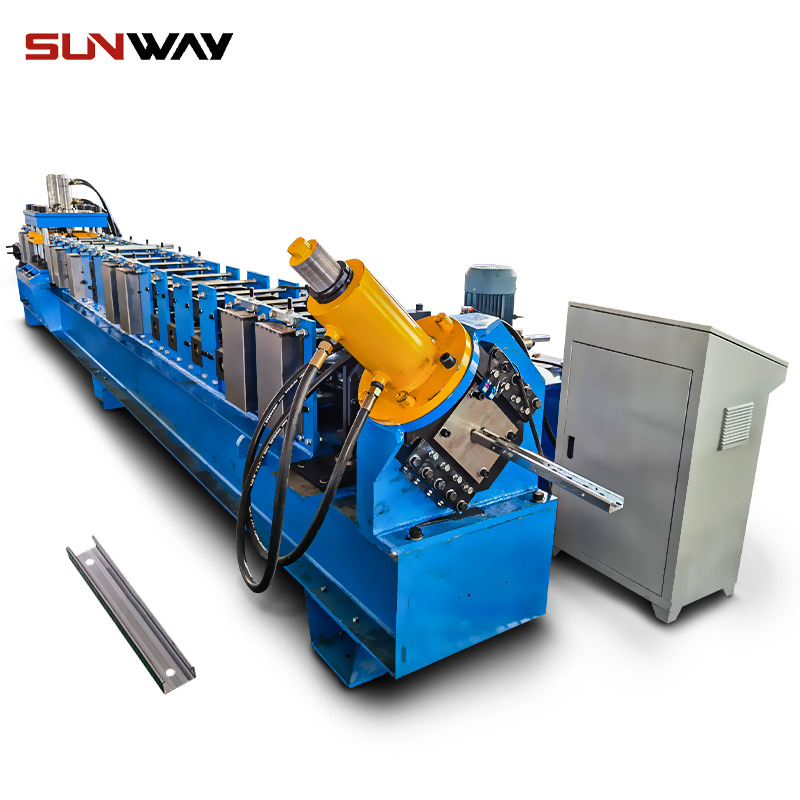
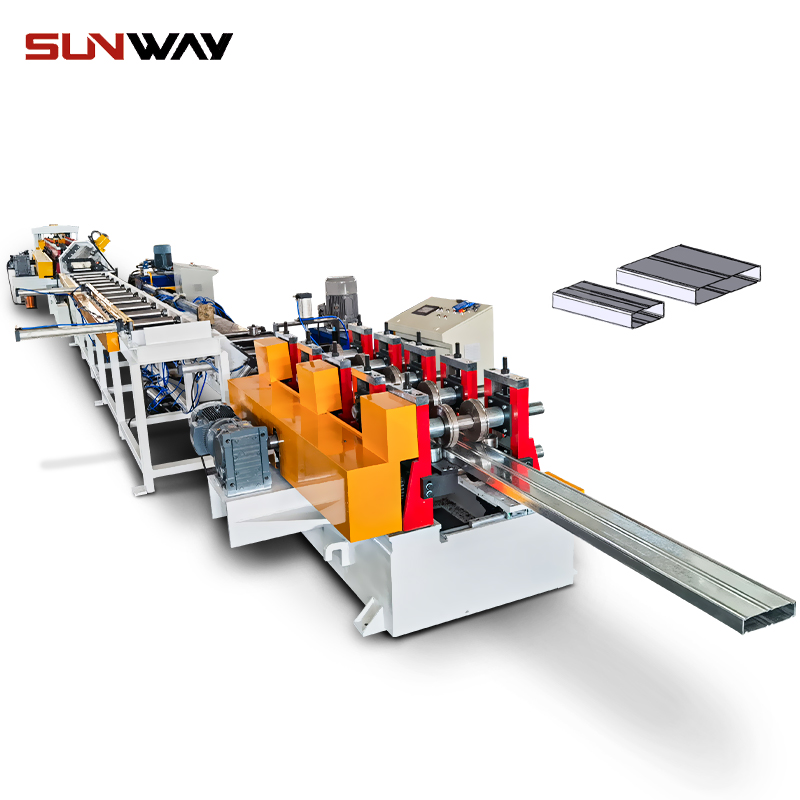
A complete automated step beam machine line transforms raw steel coils into finished, cut-to-length step beam profiles through an integrated four-stage process:
Heavy-Duty Decoiling & Precision Leveling: Steel coils (such as Q235, Q355, or high-tensile structural steel) are uncoiled and passed through a multi-roll precision leveler to eliminate coil set and internal material stress.
Servo Punching & Notch Preparation: An automated hydraulic punching unit punches locking pin holes, safety clip slots, and end-notch clearances with CNC pitch accuracy before forming begins.
Progressive Multi-Pass Roll Forming: The flat strip passes through 22 to 28 engineered roller stations. Each station incrementally bends the steel, establishing crisp step geometry, tight side flanges, and secure seam interlocks without thinning the material.
Flying Hydraulic Cut-Off: A profile-matched hydraulic shear cuts the moving profile to exact target lengths (±0.5mm) on the fly, producing clean, burr-free ends that move directly to automatic end-connector welding.
Flexibility & Agility: Auto-Servo & Cassette Tooling Configurations
Racking manufacturers often need to produce a wide mix of products, from light-duty step beam shelving profiles to heavy-duty industrial step beam pallet racking beams with deeper steps and thicker wall gauges (1.5mm - 2.5mm).
Auto-Servo Width & Height Adjustment: SUNWAY’s advanced step beam machinery incorporates motorized, servo-driven width and height positioning. Machine operators select pre-programmed profile recipes on the touchscreen PLC, and the machine automatically adjusts forming stands along linear guide rails to new dimensions in under two minutes.
Modular Cassette Quick-Change Technology: For major changes in profile geometry, modular cassette quick-change sub-assemblies allow complete roller sets to be swapped out in under 15 minutes, maximizing overall equipment effectiveness (OEE).
System-Level Assembly: Matching Step Beams to Upright Columns
A rack installation functions as a unified system. High-precision manufacturing on a step beam machine ensures that beam end-connector claws mate cleanly with vertical upright column slots. Maintaining consistent hole pitch spacing and flat connector mounting faces prevents installation delays and guarantees uniform load distribution across high-bay pallet racking structures.