


Mastering 90° Step Recess Precision & Fast Width Adjustment in Pallet Rack Step Beam Roll Forming
October 29, 2026
In heavy-duty warehouse storage and standard pallet racking systems, horizontal step beams serve as the primary structural bridge transferring pallet and decking loads directly into the vertical upright frames.
Unlike flat tubular profiles, a step beam features an integrated recessed ledge (typically 20 mm to 25 mm deep) engineered to support wire mesh decking, drop-in steel panels, or timber shelves flush with the top beam surface.
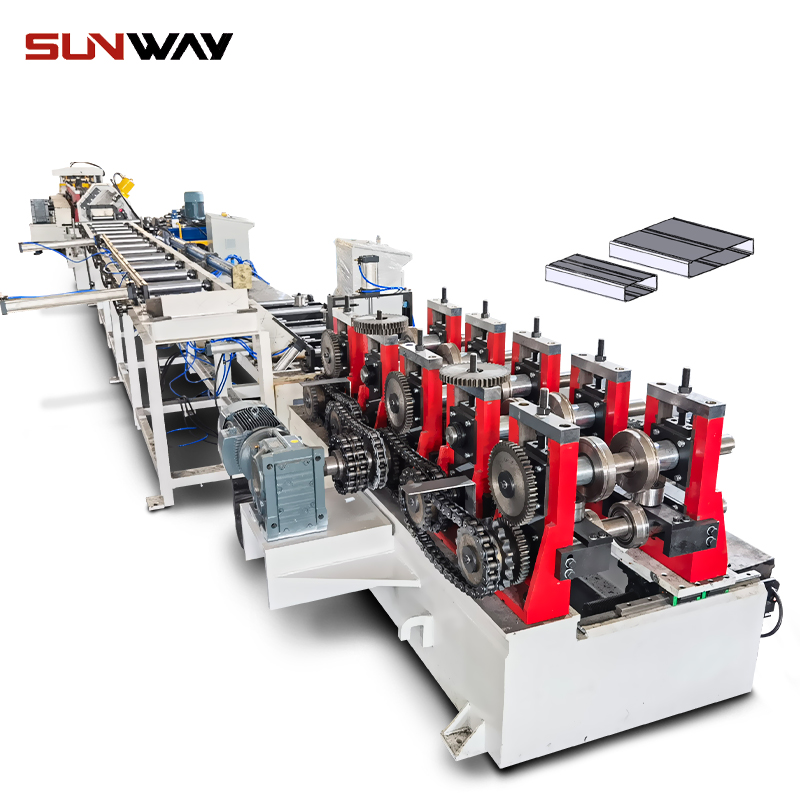
To manufacture these critical components efficiently, rack fabricators rely on a high-precision step beam roll forming machine or an automated pallet rack step beam production line.
However, forming complex step geometries from 1.5 mm−2.5 mm high-tensile structural steel introduces two major engineering bottlenecks:
1.Angle springback and irregular radius formation along the multi-bend 90° step recess, resulting in unstable decking placement.
2.Excessive downtime during profile size changeovers, where manual roll swapping can stall production for 4 to 8 hours.
This technical guide explores the tooling flower design, elastic over-bending principles, and automated adjustment mechanisms required to achieve tight profile tolerances and flexible production.
The Mechanical Demands on Modern Step Beams
Pallet rack step beams are subject to combined vertical bending moments from distributed pallet loads and lateral torsional forces during forklift loading cycles.
If the interior 90° step recess deviates by even 1.5° or develops an oversized inner bend radius, drop-in wire decking will rock or sit unevenly under load. Furthermore, poor corner definition reduces the effective cross-sectional modulus, lowering total load ratings and failing structural safety inspections (such as ANSI MH16.1 or EN 15512).
Controlling 90° Step Angle Springback & Corner Radii
Forming a step profile requires consecutive cold bends in close proximity. As high-strength coiled steel (e.g., Q235B, ASTM A1011, or Q355B) passes through the forming stations, localized strain hardening and elastic recovery cause the outer flanges to flare outward.
To maintain a step recess dimensional tolerance of ≤±0.2 mm, roll tooling engineers implement three core design strategies:
1. Progressive Over-Bending in Calibration Stations
In the final forming passes (typically stations 16 through 22), the profile is intentionally over-bent past 90° (e.g., to 92.5°) before being calibrated back to a true right angle in the final sizing stands. This controlled plastic over-deformation permanently sets the crystal lattice of the steel, neutralizing residual elastic springback.
2. Multi-Pass Corner Coining and Stiffener Definition
Rather than forcing a sharp corner in early passes—which risks micro-cracking the steel strip—the inner radius is gradually established using precision-ground convex and concave tooling passes. Coining rolls apply controlled radial compressive force at the bend radius to eliminate radius asymmetry.
3. Tightly Hemmed Bottom Lock for Enhanced Torsional Stiffness
The lower portion of the step beam incorporates a hemmed safety return or interlocking seam. Tooling passes must flatten and clinch this double-layered joint tightly with zero air gap, significantly increasing the beam's overall torsional resistance against rotational buckling.
Flexible Manufacturing: Motorized & Servo Width-Adjustable Tooling
In modern contract racking manufacturing, production schedules demand frequent profile transitions—switching between light-duty 50 mm beam heights for retail shelving and heavy-duty 120 mm or 140 mm beams for industrial distribution centers.
Traditional fixed-shaft machines require operators to manually remove spacer rings and roll dies from 20+ forming stands, creating massive labor costs and machine idle time.
The Modern Solution: Automated Width Adjustment
To achieve true operational agility, leading manufacturers deploy step beam roll forming width adjustable tooling systems:
1.Split-Die Roll Configuration: Roll tooling is split into fixed inner hubs and motorized sliding outer hubs mounted on precision linear guides.
2.Synchronized Servo Lead Screws: High-precision ballscrews driven by synchronized servo motors simultaneously translate all forming stands to the exact target width commanded by the central PLC.
3.Changeover Time Reduction: Product switchover time is reduced from 4+ hours down to under 15 minutes with zero physical roll disassembly, while maintaining repeatability within ±0.1 mm.
Non-Deforming High-Speed Flying Cut-Off Systems
Because step beams feature asymmetrical steps and closed lower hems, traditional downward guillotine shears cause profile collapsing and severe edge burrs.
| Feature | Standard Stop-and-Cut Shear | SUNWAY CNC Flying Hydraulic Shear |
| Cut-Off Speed | 8 – 12 m/min (Line stops) | 18 – 25 m/min (Continuous flying sync) |
| End Face Quality | Crushed step / Large burrs | Clean square cut / Zero web collapse |
| Secondary Deburring | Required before welding | Directly ready for robot connector welding |
| Length Accuracy | ±1.5 mm | ≤±0.5 mm (Servo optical encoder) |
High-performance production lines integrate a tailored contour-profile blade set made from Cr12MoV vacuum heat-treated to HRC 60–62, slicing through the cross-section smoothly without altering the step geometry.
Technical Comparison: Commercial vs. SUNWAY Heavy-Duty Step Beam Lines
| Specification | Typical Standard Roll Former | SUNWAY Heavy-Duty Automated Line |
| Material Thickness | 1.5 mm – 2.0 mm | 1.5 mm – 2.5 mm (High-Tensile Steel) |
| Step Recess Tolerance | ±0.5 mm | ≤±0.2 mm |
| Height Adjustment Method | Manual Spacer Disassembly | Motorized/Servo One-Touch Width Adjustment |
| Changeover Time | 4 – 6 Hours | 10 – 15 Minutes (via HMI Screen) |
| Straightness (Camber/Bow) | ≤2.0 mm/m | ≤1.0 mm/m (4-Axis Turk's Head) |
| Tooling Material | 45# / GCr15 Steel |
Cr12MoV / D2 (Vacuum Quenched)
|
Engineering Excellence by SUNWAY Machinery
At Wuxi Sunway Machinery Co., Ltd. (brand: SUNWAY), we design and build complete roll forming machinery tailored specifically for global storage rack manufacturers.
Our step beam production systems feature:
1.Heavy-duty cast iron memorial arch stands for maximum rigidity and vibration dampening during high-speed runs.
2.Premium electrical packages incorporating Siemens/Schneider PLCs and Yaskawa servo drives.
3.Integrated inline punching for beam safety pin holes and end connector slotting prior to roll forming.
4.100% factory pre-shipment trial runs with client-supplied coil specs, providing full coordinate measurement and video documentation.
FAQ
Q: How do you eliminate 90° step recess angle springback in step beam roll forming?
A: By implementing progressive over-bending techniques in calibration passes (stations 16-22) where the profile is temporarily bent to 92.5° before final sizing, combined with corner coining rolls that neutralize residual elastic stress in high-yield structural steel.
A: By implementing progressive over-bending techniques in calibration passes (stations 16-22) where the profile is temporarily bent to 92.5° before final sizing, combined with corner coining rolls that neutralize residual elastic stress in high-yield structural steel.
Q: How fast is profile height changeover with motorized width-adjustable tooling?
A: Motorized and servo-driven width-adjustable tooling allows operators to change beam height (from 50 mm to 140 mm) in under 15 minutes directly via the PLC touchscreen HMI, eliminating the 4 to 8 hours required for manual roll disassembly.
A: Motorized and servo-driven width-adjustable tooling allows operators to change beam height (from 50 mm to 140 mm) in under 15 minutes directly via the PLC touchscreen HMI, eliminating the 4 to 8 hours required for manual roll disassembly.
Q: Why is CNC flying cold saw cutting preferred over traditional hydraulic shear for step beams?
A: A CNC flying cold saw provides a clean, square end cut (within ±0.5 mm) without crushing the asymmetric step ledge or hemmed bottom seam, producing burr-free profiles directly ready for robotic bracket welding without secondary deburring.
A: A CNC flying cold saw provides a clean, square end cut (within ±0.5 mm) without crushing the asymmetric step ledge or hemmed bottom seam, producing burr-free profiles directly ready for robotic bracket welding without secondary deburring.
Conclusion & Next Steps
Delivering structurally sound pallet rack step beams demands an integrated approach: precision over-bending passes to lock in the 90° step angle, motorized adjustable tooling to eliminate changeover bottlenecks, and non-deforming flying cut-off systems.
Upgrading your step beam production or planning a new automated rack manufacturing line?
Contact the engineering team at SUNWAY today to submit your profile drawings for a free tooling feasibility analysis and customized machine layout.
Contact the engineering team at SUNWAY today to submit your profile drawings for a free tooling feasibility analysis and customized machine layout.
Related News
2026-10-27 9
Mastering Interlocking Fit & Thermal Distortion in Heavy-Duty Box Beam Roll Forming: The Definitive Welding Line Guide
2026-10-21 16
Solving Pitch Accumulation Error & Material Twisting in Heavy-Duty Upright Rack Roll Forming: An Engineer's Deep Dive
2026-10-16 22
Box Beam Roll Forming Machine: How Section Design Affects Structural Performance